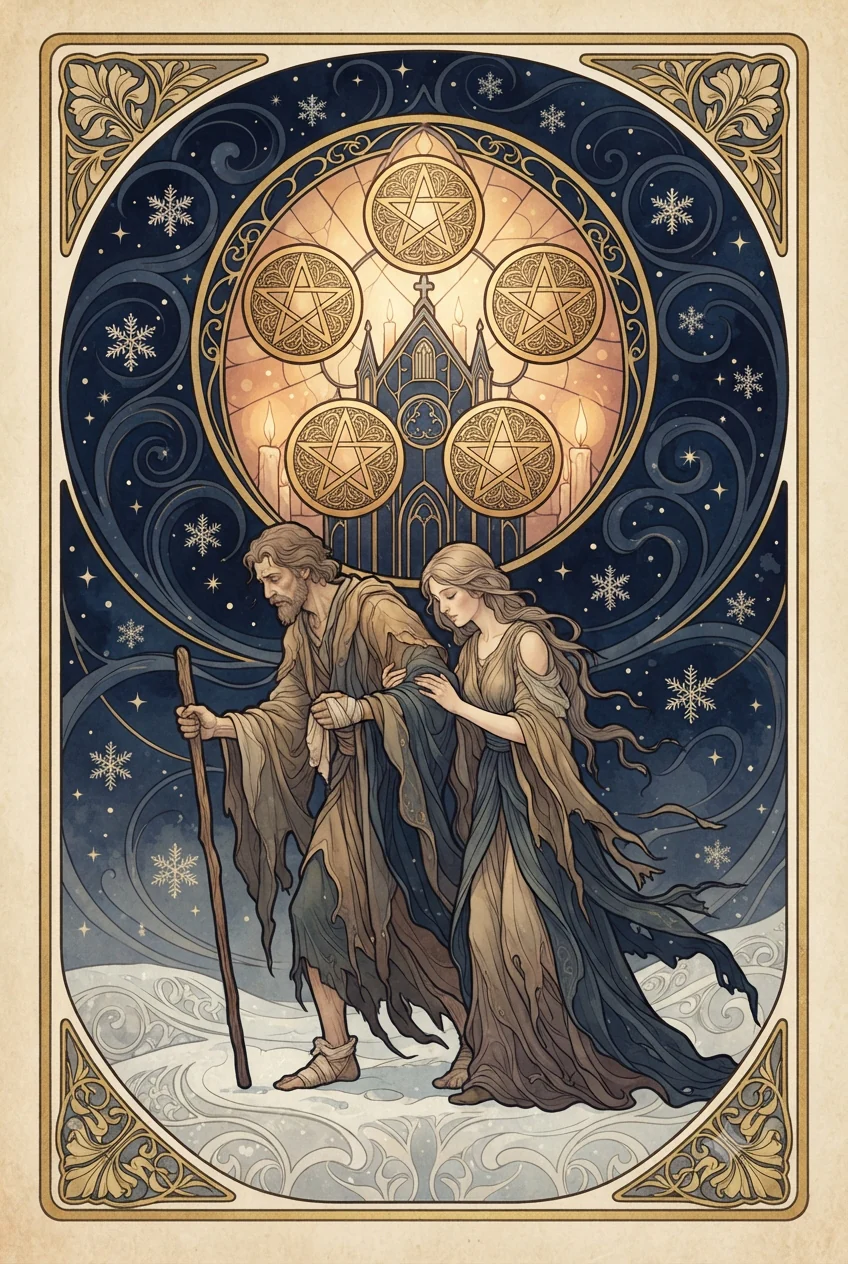
Five of Pentacles
Minor Arcana · Pentacles
Upright
HardshipA cold stretch — insecurity, exclusion.
The Five of Pentacles places you at the doorstep—close enough to see the light inside, but not inside. It asks you to look squarely at where you feel shut out or left behind. This is the moment when the paycheck runs out before the month does, or a friendship you counted on suddenly feels like a locked door. The ache is real. The cold is real. What the card holds up is not a prediction of worse to come but a question about what you believe about your own belonging. The stained glass is right there, luminous and warm. Notice whether you are telling yourself you don’t deserve to walk through. The figures in the snow don’t knock. You still can.
Reversed
End of hardshipRecovery; help arrives, the worst passes.
Reversed, the card points to the thaw. Help is arriving, or it already arrived and you are only now letting yourself feel it. The same church window glows in the same darkness, but the door is opening. This is less a sudden windfall and more the slow relief of a friend who stays on the phone past midnight, or your own stubborn decision to ask for what you need. The reversal asks you to let yourself be warm, even when you have grown used to the cold. It does not erase what left you limping—the injury is still there—but it means you are no longer walking through it alone. Acceptance, here, is its own kind of strength.
What the imagery is saying
Two figures lean into a slant of falling snow. Their clothes are thin, their steps uneven—one uses a crutch, the other walks with a limp. Their bodies show weight and exhaustion. Behind them and above, a tall church window glows, yellow and steady. Five pentacles are set into the window’s stonework, lit from within. The warmth is close enough to notice, far enough to sting. Nothing in the picture shows whether the figures have seen the window or whether they believe the door is locked. The snow keeps falling. The window keeps shining. The distance between them and the light is the whole story.
Where this shows up
In relationships
Feeling like the third wheel, the one not invited, the one whose struggles the group would rather not see. The card shows up when you are physically present but emotionally outside—shivering at the edge of someone else’s warmth. It asks what you haven’t said about what you need.
In work
The role goes to someone else. The budget tightens and you are the last to know the plan. Your contribution is overlooked. The card names the experience of being undervalued, not as a permanent verdict but as a real sting that can harden into resentment. It asks where you have stopped advocating for your own worth.
In how you relate to yourself
This is the voice that says you are the only one who doesn’t have it figured out. The cold comes from inside. The card surfaces when shame keeps you from reaching toward the lit window at all—when isolating feels safer than admitting you are struggling. It asks you to notice the story you are telling yourself about whether you belong among people who would, in fact, open the door.
Common misreadings
This card is often read as a prediction of poverty, illness, or abandonment—a sign that things will get worse. That’s a fortune-teller’s reading, and it misses the point. The Five of Pentacles is not about what is fated; it is about the very real human experience of being on the outside in a moment when help is visible but feels out of reach. The church is right there. The light is on. The card is not saying you will be cast out. It is showing you that you feel cast out right now, and it’s asking you to notice what you believe about the door. The figures are not dead. They are still walking.
Sit with this
- When did I know warmth was nearby and still chose to stay in the cold?
- What story do I tell myself about why I don’t belong, and where did I learn it?
- What form of help is already present that I have been too proud or too tired to accept?
Draw a personalized spread and receive a reflective reading that ties your cards to what’s on your mind — for self-reflection, not prediction.
Begin a free reading