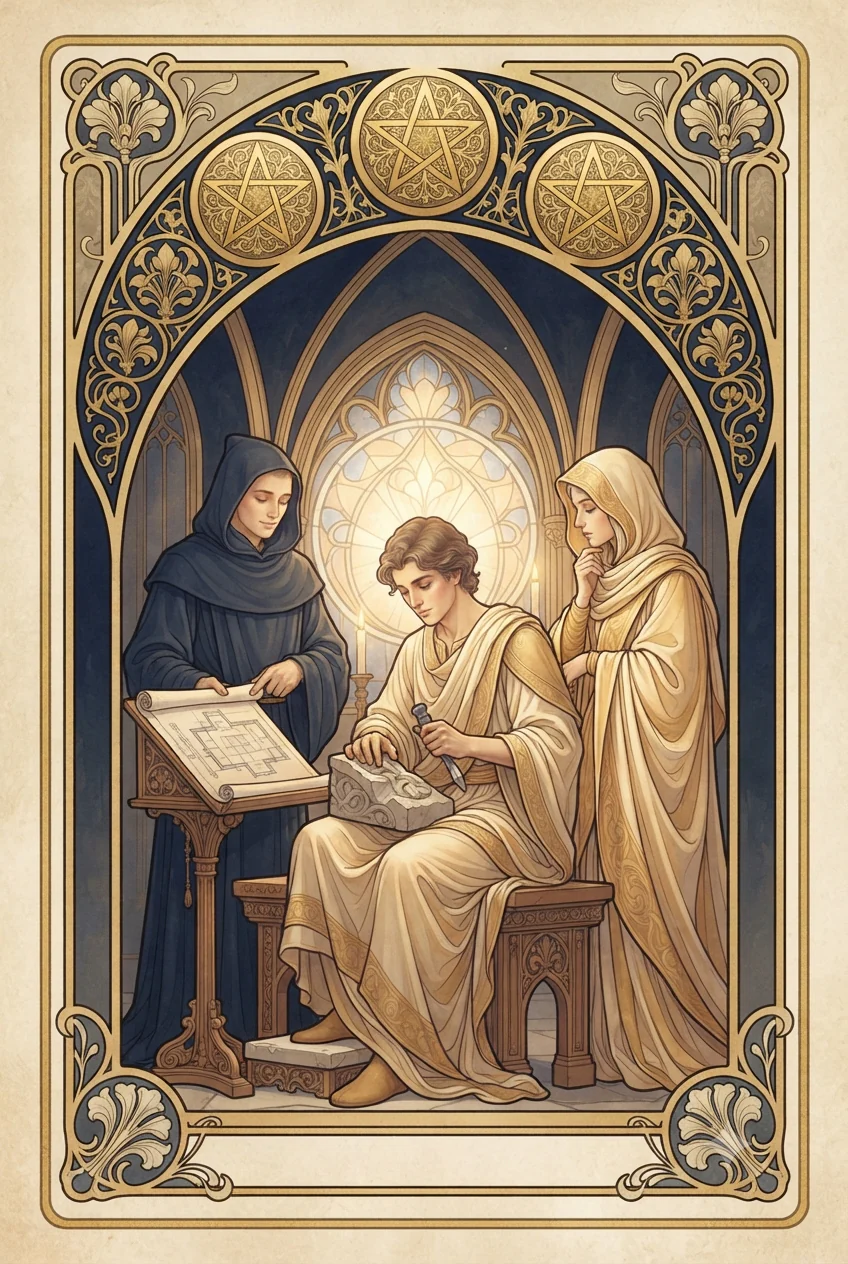
Three of Pentacles
Minor Arcana · Pentacles
Upright
TeamworkSkill and collaboration build something fine.
The Three of Pentacles turns your attention to the moment skill leaves isolation and meets another pair of hands. It asks you to notice where you are being invited to contribute your specific competence to a shared structure—a project, a renovation, a plan larger than you alone. This is not a card about solo mastery; it is about showing your work to people who can read the blueprint and improve it. It frames listening as a technical skill and feedback as material. Right now you are the craftsperson, the reviewer, or both. The card holds up the quiet satisfaction of fitting your piece into a whole that will outlast any single contributor, with the grain of the stone still under your fingers.
Reversed
Poor qualityFriction in the team; corners cut.
Reversed, the Three of Pentacles brings friction into the workspace—tools blamed for the user’s impatience, shortcuts visible in the finished joint. The energy here is misaligned: someone is withholding information, phoning it in, or insisting their way is the only way. It points to the gap between the standard you can see and the standard the team is settling for. The card asks whether your own effort has become performative, whether you are nodding along to plans you have already decided to ignore, and where resentment is quietly replacing craft. Quality becomes the casualty of a group that stopped checking each other’s work.
What the imagery is saying
Three figures frame the bench. The young craftsman holds his mallet to the stone, head down in concentration, while the monk and the hooded patron study the plans. Their faces register discussion, not instruction—this is a working consultation between makers and designers. Above them the cathedral arch curves through unfinished scaffolding, three carved pentacles set into the stone like signed checkpoints. The bench is not a stage; it is a workstation with dust on it. The plans on the parchment occupy the exact center of the image, pulling three pairs of hands into a single point of reference.
Where this shows up
In relationships
Shared labor bonds people as much as shared feeling. Here the relationship shows up as a project under joint construction—a home, a routine, a difficult conversation that needs both parties holding the same diagram. When one person withholds skill or stops showing up for the building phase, the structure lists.
In work
This card describes the collaborative stretch where individual expertise is slotted into a team timeline. It appears when the work requires review cycles, critical feedback, and the humility to revise. The quality of the cathedral depends on the carpenter telling the stonecutter the arch is off.
In how you relate to yourself
The internal version of this card is the discipline that builds skill through repeated correction. It is your own hand checking yesterday’s work against a higher standard. Here the three figures live inside you—the maker, the reviewer, and the one holding the long-range plan—and they are either cooperating or undermining each other.
Common misreadings
The most common misreading flattens the Three of Pentacles into a simple career prediction: “a promotion is coming,” “your team will succeed.” That turns the card into a passive receipt rather than an active worksite. It is not a forecast of recognition or a guarantee that the group project ends well. The card names a process, not a payoff. You stand inside the moment of collaboration itself, with chalk dust on your sleeve and a real choice to listen, to speak up about a flaw, or to match your effort to the plan. The cathedral may take a century; that is not the point. The point is what you make today and who you make it with.
Sit with this
- When did I last let someone look at my unfinished work and actually use their feedback?
- Where in my life am I nodding along to the plan while quietly ignoring it in execution?
- What standard of quality am I willing to defend even if it slows the group down?
Draw a personalized spread and receive a reflective reading that ties your cards to what’s on your mind — for self-reflection, not prediction.
Begin a free reading