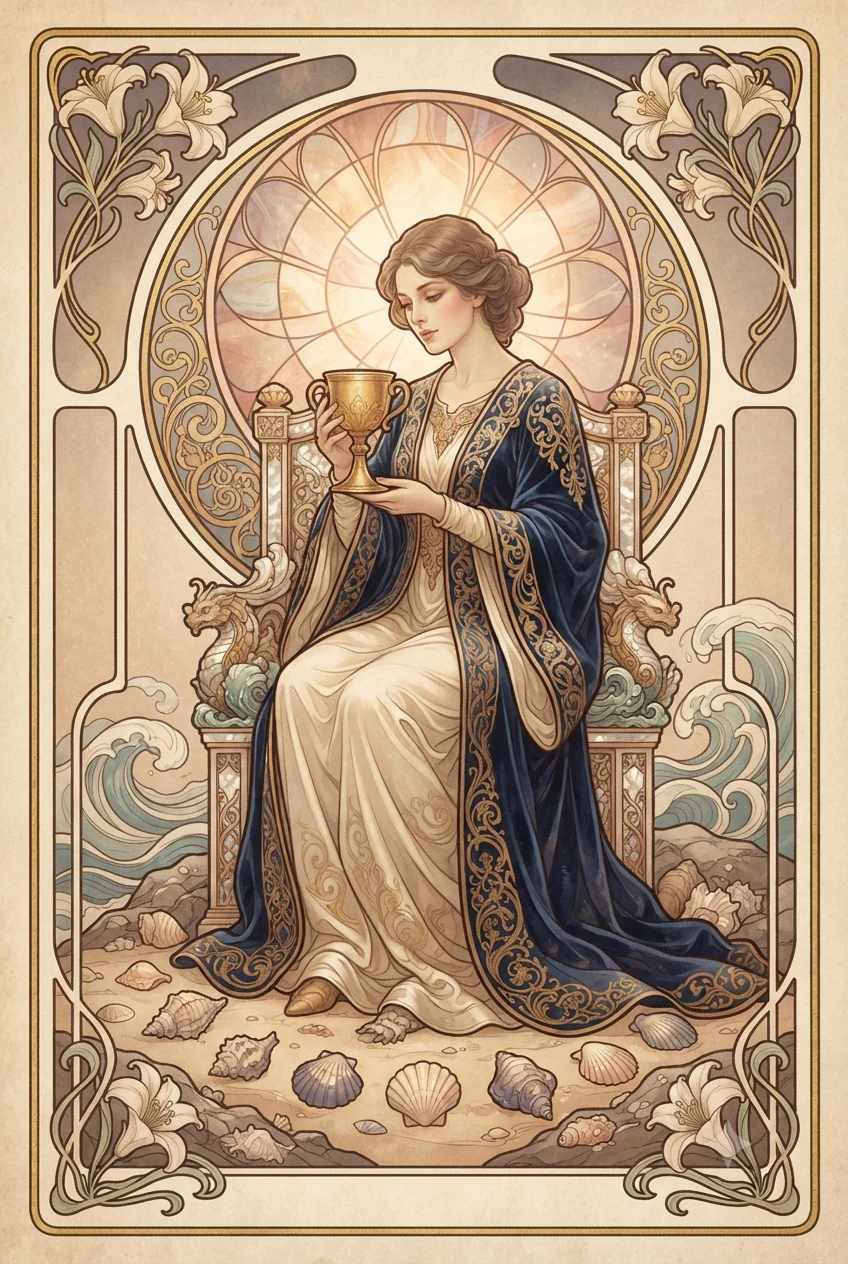
Queen of Cups
Minor Arcana · Cups
Upright
CompassionEmotional security held with deep care.
Compassion, for the Queen of Cups, is not a passive softness. It is a structured container strong enough to hold the full weight of another's inner world without leaking or breaking. She watches the cup in her hands with a steady, unhurried focus. Nothing in her posture flinches. Emotional security, in this light, is not the absence of difficult feeling — it is the deliberate, attentive presence that lets feeling be fully felt and named. The card places this capacity directly in front of you right now. Notice where you already have the steadiness to sit with something messy or tender without needing to fix it. Notice where your listening becomes a shelter. The upright card asks you to recognize that your ability to hold space for others is a practiced skill, not a reflex, and that the care you extend outward must first be something you know how to give yourself.
Reversed
MartyrdomOver-giving to your own depletion.
The reversed Queen of Cups points to a familiar and painful pattern: giving until the body itself begins to protest. The golden cup is still in the scene, but the focus shifts from attentive holding to anxious pouring-out. Martyrdom is not generosity. It is the quiet bargain where you trade your own depletion for a sense of being needed, often without anyone having asked for the trade. Right now, this card places that drained version of caring in front of you. Notice where your emotional labor has crossed from chosen into compulsory. Notice the resentment that seeps in when you say yes but mean no, or when you silently keep score. The reversal does not condemn your kindness. It simply, firmly asks you to see the cost of care that has no boundary, and to recognize that a cup emptied entirely holds nothing for anyone — least of all for yourself.
What the imagery is saying
The throne is shoreline stone — ornate but half-claimed by salt and tide. The queen does not sit above the water; she sits within its reach. Waves curl around the base of the throne and scattered shells rest near her feet. She is not looking at the sea. Her gaze is lowered, entirely held by a closed golden cup with a handle. The cup is not raised in a toast or display; it is held close to her body, both hands steady around it. A closed vessel, not an open one. The handle suggests something meant to be carried. The waves approach but do not disturb her, because her attention is on what she is holding, not on the breadth of the ocean. The shells at her feet are tokens of the shore — small, solid, formed by long exposure to water. She has not turned away from feeling. She has learned to sit beside it without drowning.
Where this shows up
In relationships
The upright Queen of Cups shows up where one person holds steady while another processes strong emotion — hearing anger, grief, or fear without absorbing it. In reversal, the pattern shifts to emotional over-functioning. You become the sole caretaker of the other's moods, draining yourself in the name of love. Resentment here often masks a fear that your worth is tied to how much you can endure.
In work
Upright, this card points to roles where emotional attunement is a core skill — counseling, teaching, managing teams, tending to coworkers' morale without losing sight of your own workload. Reversed, the pattern shows emotional labor being treated as invisible and unlimited. You absorb office tension, take on others' stress, and handle relational maintenance no one else volunteers for — running on empty as a result.
In how you relate to yourself
Upright, the Queen of Cups reflects a private capacity to sit with sadness, fear, or longing without numbing it. It is the inner posture of someone who knows their own depths and does not flinch. Reversed, the care you easily give to others stops at your own doorstep. You ignore your own fatigue, skip rest, and feel discomfort receiving the very kindness you offer so freely. The empty cup is your own.
Common misreadings
The most common misreading turns the Queen of Cups into a promise about another person's feelings — a sensitive partner arriving, a loving woman entering your life, a confession of love coming. This card does not predict what someone else will do or feel. The closed cup is not hiding a message about your future. It reflects a quality of emotional presence you already possess or are invited to cultivate right now. In reversal, the misreading frames martyrdom as proof of devotion — see how much I give, see how selfless I am — rather than recognizing it as erosion of your own capacity. The correction: depletion is not a virtue. It is a warning that the boundary line has been crossed.
Sit with this
- When did you last give someone your full attention, and what did you notice in their face or voice that you would have otherwise missed?
- Where in your life right now does care feel like a choice you keep making, and where does it feel like a requirement you can't put down?
- Describe a moment when you received kindness that asked for nothing in return. What did your body do with that feeling?
Draw a personalized spread and receive a reflective reading that ties your cards to what’s on your mind — for self-reflection, not prediction.
Begin a free reading