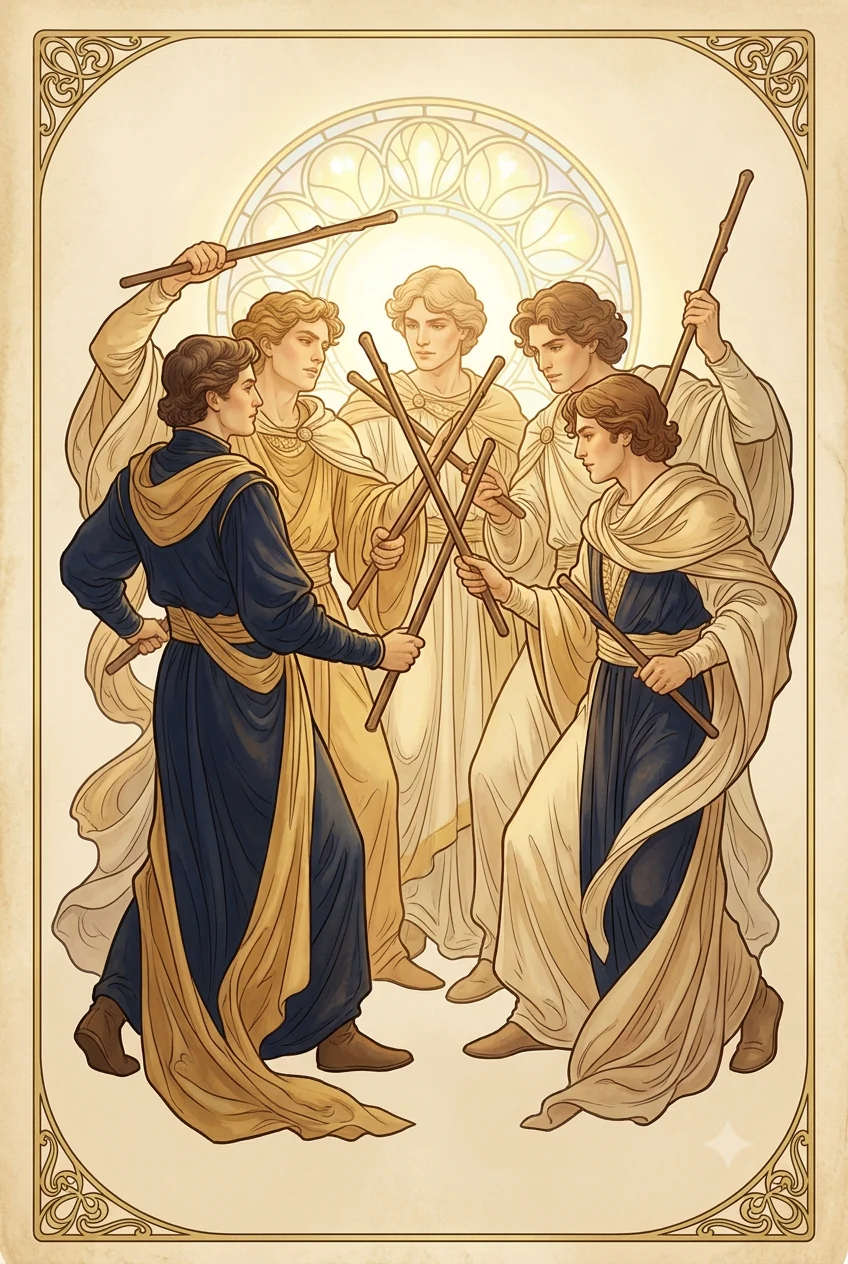
Five of Wands
Minor Arcana · Wands
Upright
CompetitionFriction, rivalry, the clash of strong wills.
The Five of Wands turns the mirror toward the part of you that thrives on friction. Not the part that wants to win — the part that wants to stay in the scrum because the heat of disagreement feels more alive than quiet agreement. These five figures aren't enemies. They're in the same tunics, holding the same wands, playing at the same game. The card asks what you're really contesting. Is it the stated disagreement, or is it about being seen as capable, having your voice land, proving your ideas deserve space? Competition sharpens, yes. It also exhausts. It can disguise a need for recognition as a need for victory. Look at how much of the conflict in front of you is structural — two valid positions that can't both fit in the same plan — and how much is performative. How much is simply the pleasure of matching strength against strength. The card doesn't ask you to put the wand down. It asks you to notice why you picked it up, and whether you're still aiming at the person across from you or at something older inside yourself.
Reversed
ResolutionConflict avoided or finally resolved.
Reversed, the clash has quieted — or been silenced. The wands are lowered, the field cleared. But resolution isn't the same as peace. The card asks you to look at what ended the skirmish. Did you work through the disagreement until a real third option emerged, or did someone walk away to keep the peace, swallowing what they actually needed to say? Avoided conflict leaves a residue. You can feel it in the politeness that replaced the shouting, the careful distance where there used to be heat. If the conflict is genuinely resolved, notice what was surrendered to get there. Resolution always costs something — a position, a preference, a story about being right. The card doesn't congratulate you on harmony. It asks whether the quiet holds integrity or resentment, and whether anything important got lost when the wands stopped clattering.
What the imagery is saying
Five young figures in matching tunics stand on open ground, each gripping a tall wand. The wands cross in a tangle above their heads — some strike against others, some miss, some just fill the air. No two are held the same way. One figure leans forward, weight committed. Another stands planted, wand angled defensively. A third gestures sideways, not even aiming at anyone in particular. It's a mock skirmish, not a battle. The faces aren't angry. Some are laughing. The ground underfoot is trampled but not torn up. Nothing is at stake except pride, position, the joy of testing strength. The sky is clear. There is no referee, no audience. Just five people on a field, deciding how hard to swing.
Where this shows up
In relationships
A friendship or partnership where disagreement has become a form of connection — bickering, debating, one-upping. The friction feels intimate, even essential, but it may also be covering for something unspoken: an old hurt, a boundary that needs setting, a fear that if the sparring stops, the relationship loses its energy.
In work
A team jostling for influence, credit, or airtime. Ideas compete rather than build. The productive side is creative abrasion — sharp thinking, stress-tested proposals. The draining side is when the process becomes the point, and no decision lands because every player needs their wand in the air.
In how you relate to yourself
An internal crowd of competing urges. The drive to be impressive collides with the need to belong. The part of you that wants recognition wrestles the part that thinks wanting recognition is shallow. You're not fragmented — you're in tension. The card asks which inner voice you're asking to sit down, and which one you keep handing the wand back to.
Common misreadings
The most common misreading treats this card as a warning of imminent struggle or a sign that conflict is destined to escalate. That is not what the image shows. These five figures chose the field. They chose the wands. Nothing is happening to them. The card does not predict a fight — it asks you to recognize that you are already holding a wand, already standing on the field, already deciding how hard to swing. Another misreading casts competition as inherently destructive. The correction is to see the card as a mirror for your relationship to disagreement: what you seek in it, what it costs, and whether you're still choosing it freely.
Sit with this
- Describe a recent conflict where the heat of disagreement felt energizing rather than threatening. What were you actually fighting for?
- If all five of these figures are different parts of you, which two are clashing the most right now — and what does each one want?
- Think of a disagreement you chose not to engage in. What did you keep by staying silent, and what did you lose?
Draw a personalized spread and receive a reflective reading that ties your cards to what’s on your mind — for self-reflection, not prediction.
Begin a free reading