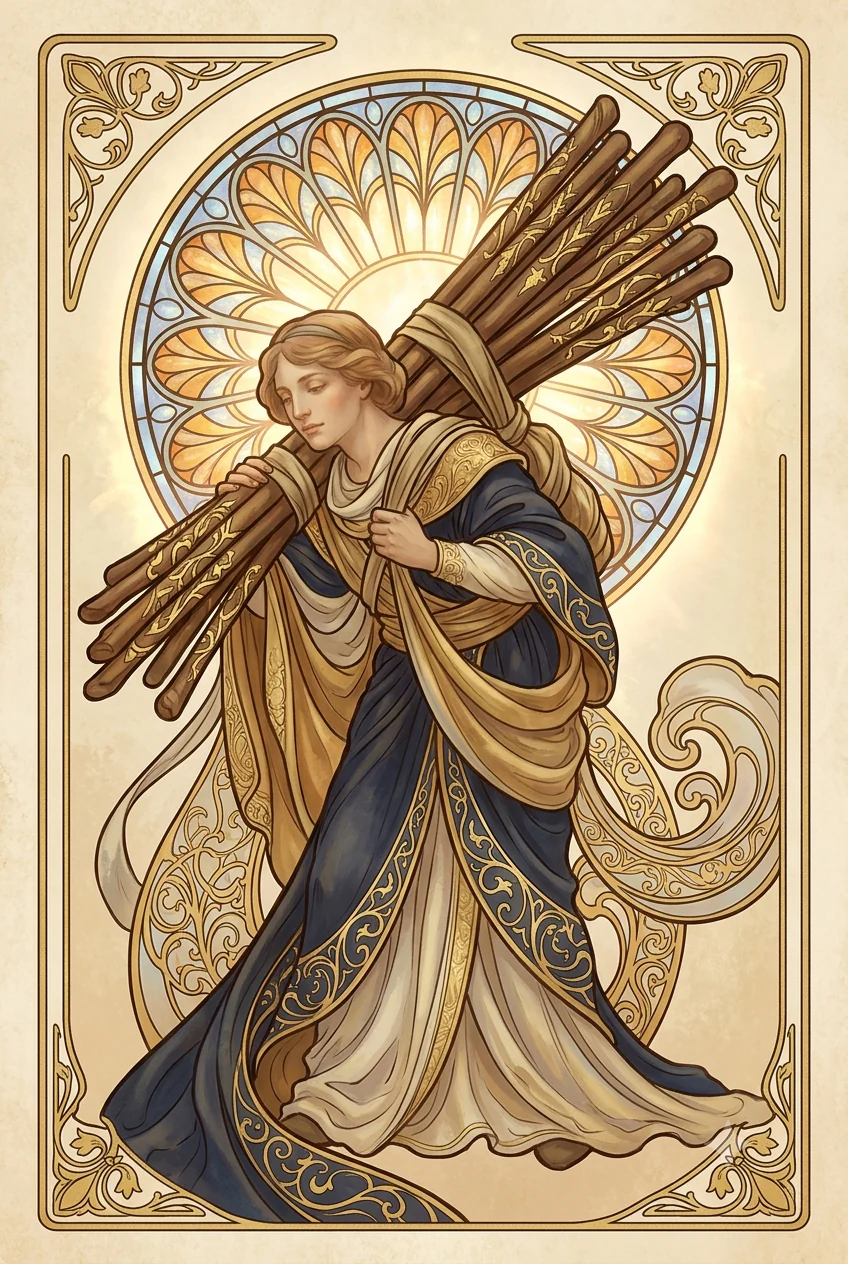
Ten of Wands
Minor Arcana · Wands
Upright
BurdenCarrying a heavy load of responsibility.
You are the one who said yes one too many times. The weight in your arms right now is real — deadlines, obligations, promises you made when you had less on your plate. The Ten of Wands doesn't ask whether you're strong enough; it asks whether the load is worth what it costs you to carry it. Some of these wands are duties you chose, and some are duties that chose you, but right now the distinction hardly matters because your back is bending under the total. The card holds up a mirror to a moment of overload. Not burnout — that comes later. This is the moment before, when you can still feel exactly how heavy everything has become and you haven't yet admitted it out loud. The town on the horizon is the finish line you keep staring at, the one that justifies the strain. Look at how far away it still is. Notice what you're not seeing because your arms are full. Notice who isn't helping you carry this.
Reversed
ReleaseSetting down a weight, delegating at last.
The wands are already beginning to fall, or you are finally letting them. Reversed, the Ten of Wands names the moment of release — not the relief after, but the decision to set something down while the weight is still in your hands. This is the card of the uncomfortable conversation where you tell someone you can't take on their share anymore. It's the email you draft and delete three times before sending. Delegation sounds clean in theory; in practice it feels like failure, like letting people down, like admitting the limits you've been pretending aren't there. The reversed card doesn't congratulate you on self-care. It shows you what it actually costs to unbend your spine and let some of those wands hit the ground. Some responsibilities will get dropped, not handed off gracefully. Some people will be disappointed. The question isn't whether release is good — it's whether you're willing to bear the discomfort of disappointing others more than you're willing to bear the weight you're currently holding.
What the imagery is saying
A lone figure is doubled forward, arms wrapped around ten heavy wands bundled together across their chest. The wands are long, unwieldy, too many to carry comfortably — they jut outward in every direction, forcing the figure to lean into the load just to keep moving. The body tells the whole story: shoulders curved, head down, vision narrowed to the ground immediately ahead. Far in the distance sits a town, small enough to remind you how much road remains. The figure isn't collapsing and isn't heroic. They're enduring — grimly, doggedly, focused entirely on the horizon while the present moment shrinks to nothing but weight and forward motion. The wands block the figure's view of almost everything else.
Where this shows up
In relationships
You're the one who remembers the birthdays, schedules the difficult conversations, absorbs the tension at family gatherings, and keeps the shared life running while someone else gets to be spontaneous. This pattern isn't about being taken for granted — it's about whether you've ever actually asked for what you need or just assumed that carrying it all was the price of being loved. Resentment builds quietly when you're the load-bearing wall.
In work
The project that started as an opportunity has become the thing that owns your evenings and weekends. You're doing three roles because restructuring never backfilled the other two. Upright, the card names overwork you can't easily exit — the mortgage depends on it, the team depends on you, the promotion dangles just ahead. Reversed, it asks what happens if you let a deadline slip or a ball drop. Not as strategy, but as honest experiment.
In how you relate to yourself
You've built an identity around being capable. The person people count on, the one who handles it. The Ten of Wands shows what that identity costs when it runs on autopilot — when you can no longer tell which of the wands you're carrying are actual obligations and which are just proof of your own reliability. Release here might look like discovering that some of the weight you're holding is self-assigned, and nobody asked for it.
Common misreadings
The most common misreading treats this card as a prophecy of collapse — as if the figure is about to fall and the card is warning you of an impending breakdown. That's fortune-telling. The Ten of Wands isn't predicting an outcome; it's describing a present reality that you may be minimizing or justifying. A related mistake is reading reversal as 'the hard part is over,' a cheerful promise that relief has arrived. The reversed card doesn't guarantee relief. It indicates release as an available action, but one that requires you to make a choice you've been avoiding. Nobody is coming to take the wands out of your arms. The card is a description of your current posture, not a preview of the next chapter.
Sit with this
- What is one wand you're carrying right now that someone else could hold — and what stops you from handing it to them?
- When did you first learn that being dependable meant taking on more than felt fair?
- Describe what your body feels like under this load. Where is the weight sitting?
Draw a personalized spread and receive a reflective reading that ties your cards to what’s on your mind — for self-reflection, not prediction.
Begin a free reading