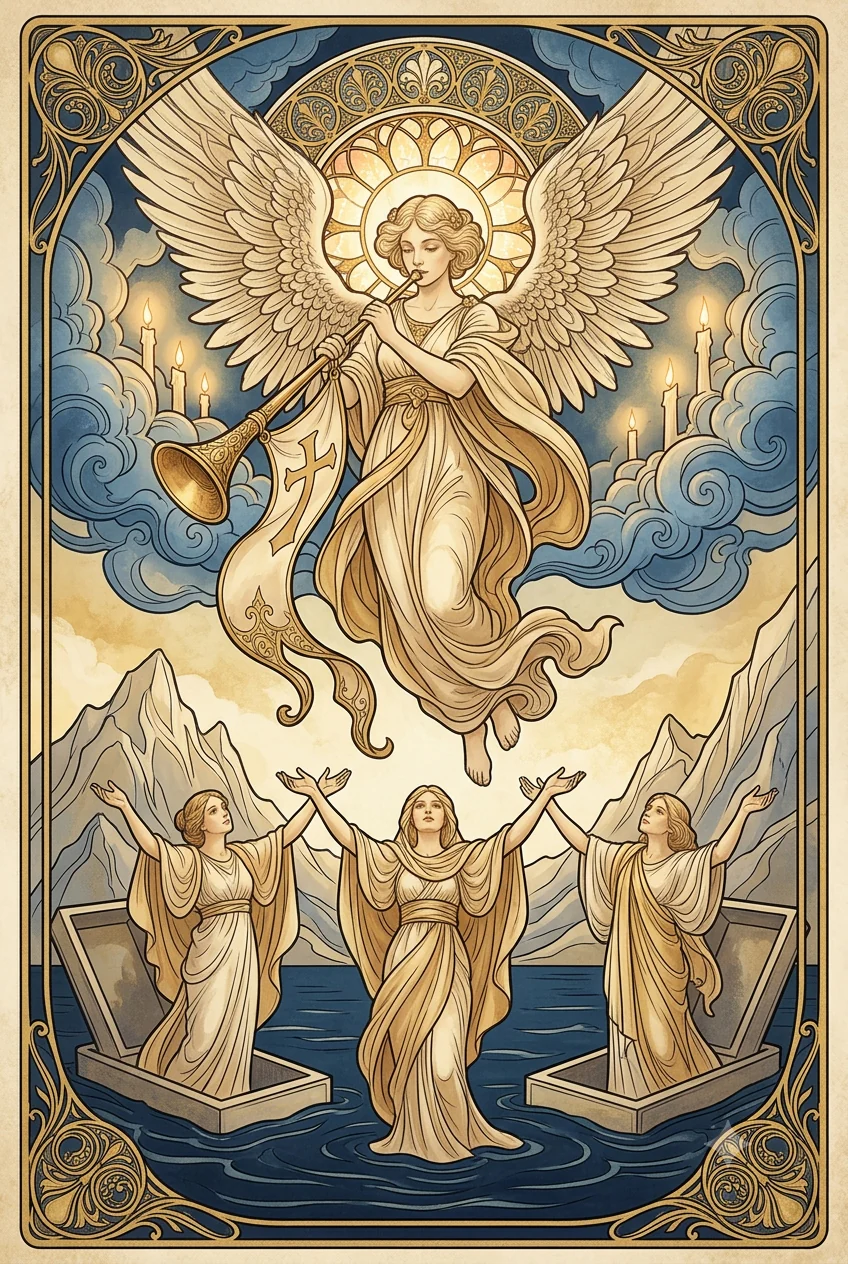
Judgement
Major Arcana · Card 20
Upright
ReckoningA call to rise, reflect, and step into a renewed self.
Judgement isn’t about a final verdict handed down from outside. It’s the moment you hear your own name in something—a piece of music, a quiet morning, a conversation that lands differently—and realize you can’t stay where you are. The card puts a single question in front of you: what is being asked of you right now, not by someone else’s rules, but by the part of you that knows what you’re here to do? Rising to that call feels like a relief and a rupture at the same time. It asks you to sift through what’s behind you, keep what’s true, and leave the rest. You don’t have to be finished or fixed. You just have to answer. The reckoning here isn’t punishment. It’s honesty catching up with you and you deciding to let it.
Reversed
Self-doubtIgnoring the call, or judging yourself too harshly.
When Judgement reverses, the trumpet is still sounding but you’ve stopped your ears. Maybe the call feels too loud, or maybe you’ve convinced yourself it’s for someone else. Self-doubt takes the driver’s seat and starts cross-examining every impulse toward change: who am I to think I can do that, what if I’m wrong, what if I fail. This isn’t humility. It’s a stuck loop masquerading as self-awareness. Sometimes the reversal shows up as harsh internal criticism that never lets anything feel finished or good enough. Other times it’s a deliberate refusal to look at what needs looking at because the quiet afterward is scarier than the noise. The figures in the card are still there, still rising. You just aren’t letting yourself join them yet.
What the imagery is saying
A winged angel dominates the upper half of the image, blowing a golden trumpet that points downward toward a cluster of rising figures. A white banner marked with a cross hangs from the trumpet’s shaft. The angel is surrounded by clouds. Below, draped human forms stand with arms open, faces turned upward, emerging from rectangular shapes that read as tombs or stone openings. Behind them, a range of sharp mountains cuts across the horizon, and a stretch of water sits between the mountains and the foreground. The angel isn’t looking at the people directly—it sounds the trumpet into the open air. The people aren’t climbing out in a panic. Their arms are already wide, their heads already lifted. The whole scene is about a sound being met with a ready answer.
Where this shows up
In relationships
A relationship reaches a point where pretending is harder than telling the truth. Someone finally says the thing that’s been sitting in the room for months. It might be an apology, a boundary, or an admission that changes the shape of everything. The card doesn’t promise repair—only the clarity that comes when you stop avoiding the conversation.
In work
You’re being asked whether your work aligns with what you actually care about. A project, a role, a whole career path can look fine on paper and still feel hollow. This is the moment you stop performing competence and start asking whether the work itself is worthy of your effort. Even a small adjustment toward honesty changes the next thing you build.
In how you relate to yourself
You recognize something you’ve been hiding from yourself. Not a flaw to fix, but a truth to acknowledge—about what you want, what you regret, or who you’ve become. The discomfort is real, but it carries an undertow of relief. You’re not breaking down. You’re waking up to your own life.
Common misreadings
The most common misreading treats Judgement as a card of literal judgment—a courtroom, a scorecard, an external authority deciding your fate. Tarot-as-fortune-telling leans into this by promising a final verdict on your choices, or worse, suggesting the card predicts punishment or reward. That’s not what’s happening here. The angel isn’t a judge reading a sentence. It’s a herald sounding a call. No one in this image is on trial. The reckoning is an honest accounting you conduct yourself, for yourself. The figures in the image are rising under their own power—they hear the note and they move. So do you.
Sit with this
- When have you recently heard something—a comment, a song, a memory—that felt like it was meant specifically for you? What did it ask you to notice?
- What would you stop doing today if you were no longer afraid of disappointing someone whose opinion you’ve outgrown?
- Describe a moment you forgave yourself for something you used to carry. What made that forgiveness possible?
Draw a personalized spread and receive a reflective reading that ties your cards to what’s on your mind — for self-reflection, not prediction.
Begin a free reading