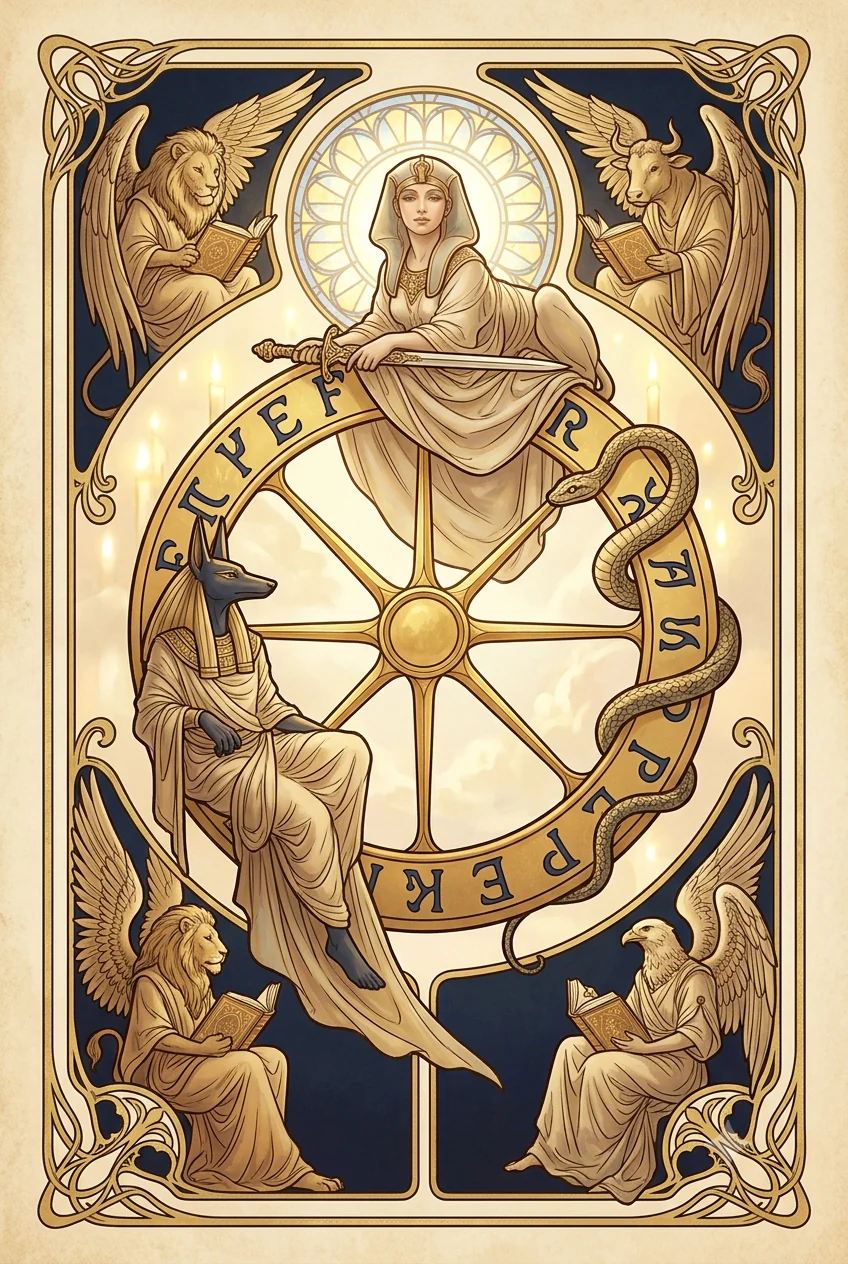
Wheel of Fortune
Major Arcana · Card 10
Upright
Turning pointCycles turn in your favor — a pivot of timing and momentum.
The Wheel of Fortune doesn't promise good luck — it points to a moment when something shifts and you feel it. Momentum picks up. A stalled situation loosens. The question isn't whether change is coming, because the card shows it already in motion. The question is whether you recognize your role in it. Timing matters, but so does attention. You might notice an opening you missed before, or feel a weight lift without a clear reason. The wheel doesn't guarantee ease — it guarantees movement. Some of that movement belongs to you: a decision you finally make, a conversation you stop avoiding, a pattern you name out loud. The sphinx on top suggests that clarity comes to those who stay watchful. The turning point lands differently when you meet it awake. Notice where you feel a sudden current. That's the place to row.
Reversed
ResistanceFighting an inevitable change, or caught at the wrong moment.
Reversed, the wheel still turns — it's your relationship to the turning that's tangled. You might be holding a door shut when it wants to open, or insisting on control when the whole situation has already moved past you. Resistance shows up as exhaustion, stubbornness, or a looping argument you keep having with yourself. Sometimes the timing feels off — you showed up ready and the room was empty, or the opportunity arrived while you were looking the other way. The card doesn't punish that. It just shows you the friction. The descending serpent and rising jackal in the image aren't enemies — they're both necessary to the cycle. This orientation asks what you're fighting and what it costs. There's a difference between patience and refusal. One waits with soft hands. The other grips something already gone. Notice which one you're doing.
What the imagery is saying
A great golden wheel dominates the center, marked with letters that suggest a language older than the scene itself. It doesn't roll on the ground — it's suspended in the sky, untethered from anything you could push or brake. A sphinx sits at the very top, still and alert, a sword held upright across its body. The sword doesn't swing; it rests. Below the sphinx, a serpent winds down the left side of the wheel, body following the curve as it descends. On the right, a jackal-headed figure rises in matching motion, climbing in the direction the serpent came from. Neither creature looks at the other. In the four corners, winged figures read from open books, intent on whatever is written there — separate from the wheel's motion but not indifferent to it. The whole image moves in a circle you can't stop, but every part of it has eyes open.
Where this shows up
In relationships
A dynamic shifts without anyone announcing it — a standoff softens, a distance closes, or a closeness that felt permanent unravels. You may not have caused it, but your response to it will shape what happens next. When the wheel shows up here, it often marks the moment when a pattern becomes visible. Someone's role in your life is changing. You get to decide whether you move with that or brace against it.
In work
Roles reorganize, a project accelerates, or something you'd sidelined suddenly demands attention. This isn't about fairness — it's about timing. The wheel in a work context often reflects an external shift you didn't engineer: funding appears, a lead departs, your responsibilities expand overnight. What matters is how quickly you recognize the new shape of things and act within it, rather than waiting for things to settle back into the old configuration.
In how you relate to yourself
An internal season changes. A belief you've carried loosens its hold, or a desire you suppressed steps forward and asks to be named. The wheel here is quiet — it's the shift in what feels possible, the sudden permission to want something different. You might not have words for it yet. You might just feel the ground tilt. That's enough. You're not the same as you were, and the card asks you to stop pretending otherwise.
Common misreadings
This card gets read as a promise — 'your luck is about to change,' 'good fortune is coming' — and that's a fortune-teller's framing, not a mirror. The Wheel of Fortune doesn't tell you what happens next. It tells you that something is already happening now and you're standing at the hinge. The wheel in the image isn't a lottery wheel. It's marked with letters, not prizes. Another misreading treats the card as permission to be passive — to wait for fate to deliver something. But the sphinx holds a sword and stays watchful. The winged figures read. Nobody in the image is asleep. The card asks for presence, not prediction.
Sit with this
- What shifted recently that you've been hesitant to name — and what became possible in the moment you noticed it?
- Where are you gripping something that has already moved on, and what would your hands do if they let go?
- When in your life did timing — not effort — change everything, and what did you learn about your own readiness in that moment?
Draw a personalized spread and receive a reflective reading that ties your cards to what’s on your mind — for self-reflection, not prediction.
Begin a free reading