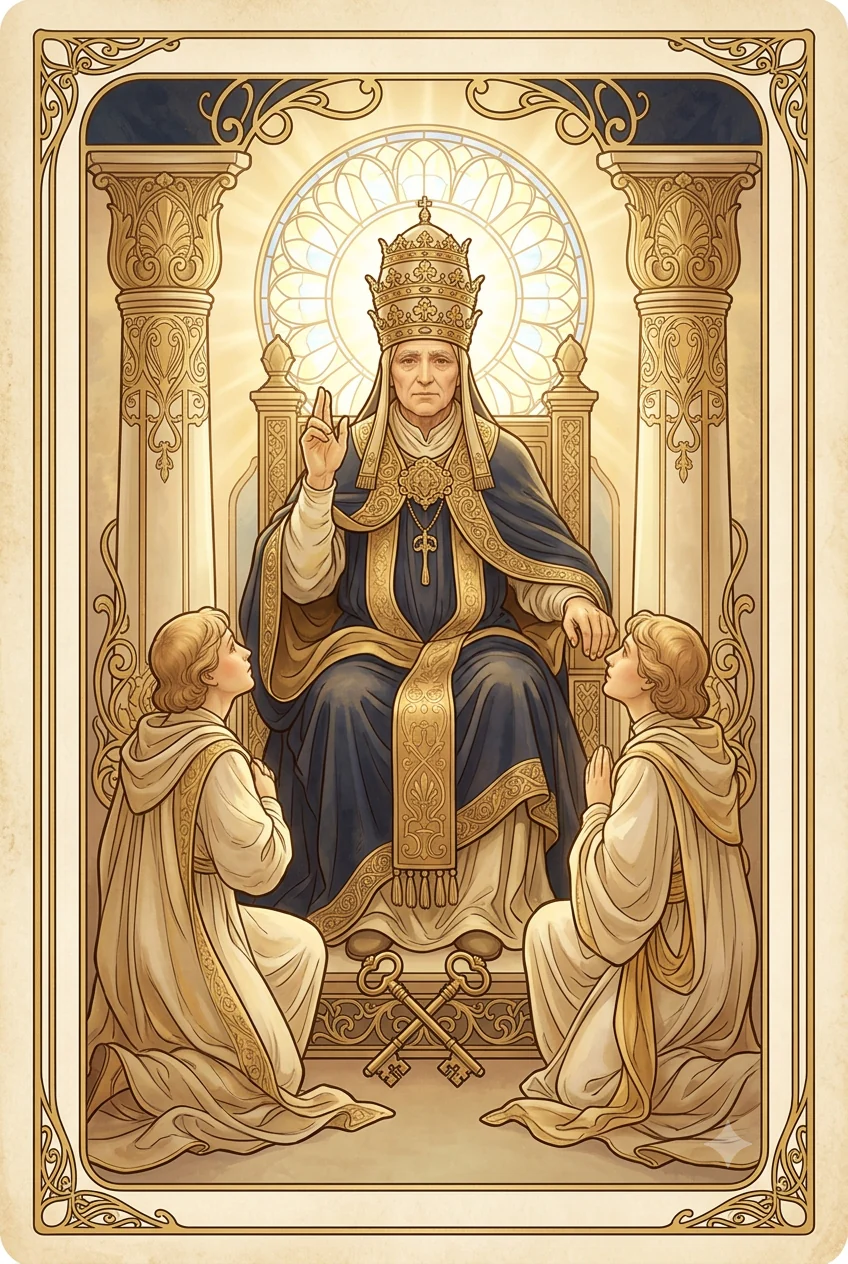
The Hierophant
Major Arcana · Card 5
Upright
TraditionGuidance through wisdom, mentorship, or shared belief.
The Hierophant upright points to the structures, teachings, and traditions that have formed you. It asks you to examine your relationship with inherited wisdom — the rules you follow, the mentors you trust, the communities whose language you speak. This is not about blind obedience. It is about recognizing which frameworks give your life shape and meaning right now. There is a reason you keep returning to certain rituals, certain texts, certain voices. The hand raised in blessing is an invitation, not a command. Notice where you are being asked to step into the role of the teacher yourself, because someone is kneeling before you, ready to receive what you have learned. The crossed keys at the card’s feet remind you that access is granted, not stolen — some doors open only when you acknowledge the tradition that built them. Ask yourself what you are part of, and whether that belonging still holds water.
Reversed
NonconformityA pull to break convention and find your own way.
Reversed, The Hierophant signals a friction with convention that has become too loud to ignore. The same structures that once offered stability may now feel like a cage, or the wisdom you inherited turns out to have cracks you cannot unsee. This card does not tell you to burn everything down. It asks whether your nonconformity is a genuine reaching toward something truer or simply a reflex — rebellion for its own sake, lonely and unmoored. Sometimes the reversed Hierophant shows up when you are clinging to an outsider identity so tightly that it becomes its own rigid doctrine. The pillar you lean on has shifted. The acolytes have looked up and noticed the throne is empty. You are being asked to construct meaning from direct experience rather than secondhand authority, a task that demands both humility and nerve. What do you believe when no one is watching? That question is the threshold.
What the imagery is saying
The elder sits between two pillars, stone and stillness framing a figure of living authority. The triple crown layers one responsibility on top of another — spiritual, institutional, and inner knowing all occupying the same head. The raised hand holds a blessing that is also a boundary: it offers something, but requires a pause, a lowering of the eyes, a choice to receive. Two acolytes kneel, their posture identical, their faces likely searching. They have come to this throne the way anyone comes to a source of guidance — carrying a question they cannot answer alone. At the elder’s feet lie a pair of crossed keys, heavy and deliberate. Keys imply a door, and the crossing suggests that no single key works alone. Access here is a matter of relationship, not force.
Where this shows up
In relationships
A relationship pattern echoes the Hierophant when roles, rituals, or shared belief systems define the bond more than spontaneous feeling does. This can show up as a mentor-mentee dynamic, a union shaped by cultural or religious expectations, or simply a partnership that runs on agreed-upon scripts. Notice which traditions you are upholding together and whether those scripts still sound like you.
In work
In work, the card highlights institutional knowledge, formal training, and the chain of command. You may be the person who knows how things are done around here, or you may be the person sitting at the feet of that person. It can point to accreditation, apprenticeship, or a workplace culture so deep you can no longer see the water you swim in — for better or worse.
In how you relate to yourself
The Hierophant in a self-reading asks about your relationship with authority, both inner and outer. You carry a code — ethical, spiritual, familial — even if you have never named it. Look at the rules you live by and trace them back. Where did they come from, and do they still speak in a voice you recognize as your own?
Common misreadings
The most common misreading treats this card as a prediction of marriage, a religious ceremony, or an encounter with an official institution. That reading reduces a living spiritual archetype to a calendar entry. The Hierophant is not a wedding invitation. It is not a sign that paperwork will go smoothly or that a literal priest is about to appear. Its domain is the inner architecture of belief and the outer structures that embody it — the why and how of tradition, not the when. Another mistake is assuming the card always affirms orthodoxy. The Hierophant can just as easily ask you to examine what your orthodoxy has cost you.
Sit with this
- Describe a rule you were taught that you still follow. Who taught it to you, and do they still hold authority in your life?
- When was the last time you taught someone something important without being asked? What did you pass on?
- If you stripped away every label given to you by family, culture, or institution, what belief would remain standing at your core?
Draw a personalized spread and receive a reflective reading that ties your cards to what’s on your mind — for self-reflection, not prediction.
Begin a free reading