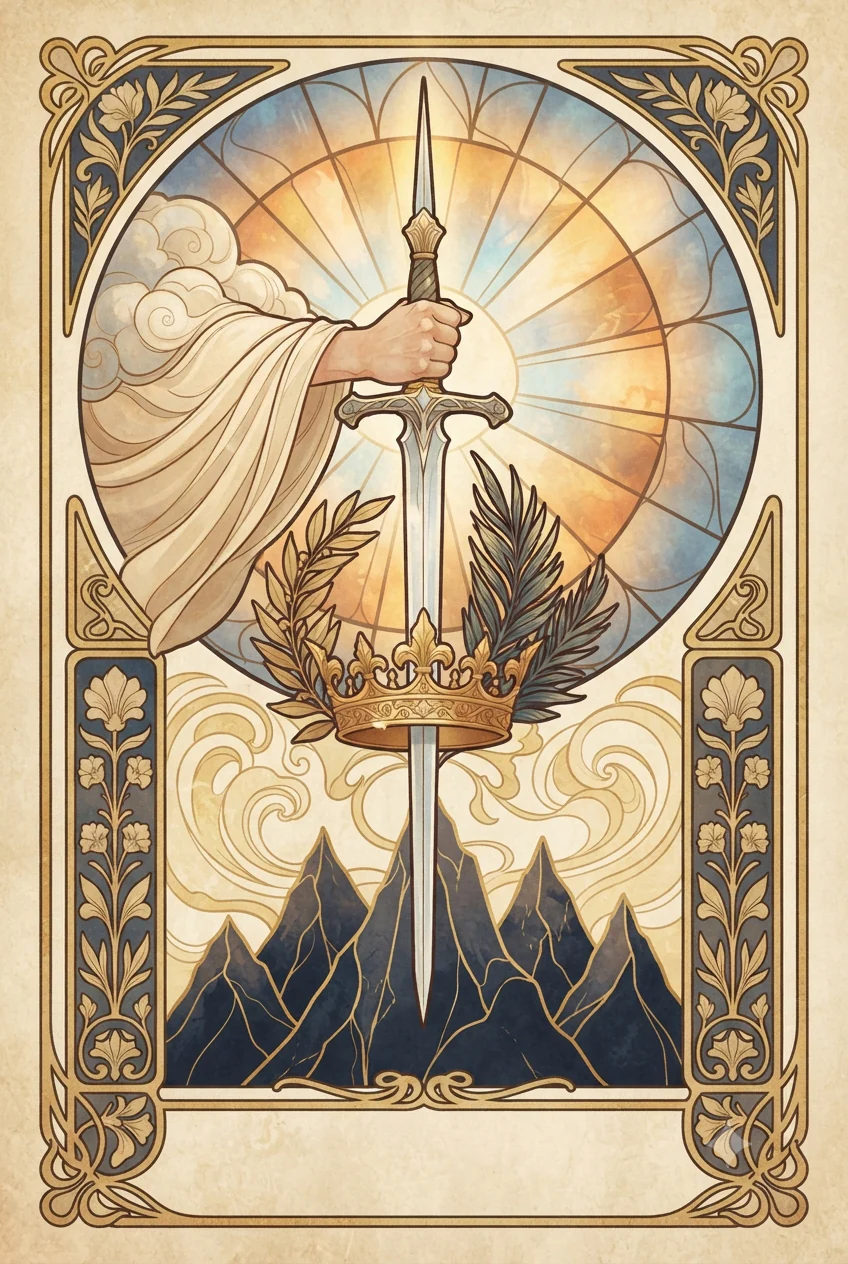
Ace of Swords
Minor Arcana · Swords
Upright
BreakthroughSharp clarity and a decisive truth.
The Ace of Swords doesn't ask whether the truth is comfortable. It asks whether you're willing to see what's actually there. This is the moment when a scattered pile of facts suddenly locks into a single, undeniable shape — an insight that cuts through justifications, polite fictions, and the stories you've been telling yourself to keep things manageable. The card points to the part of you that already knows the answer and has been waiting for permission to say it out loud. The breakthrough itself is clean. The aftermath is not. Clarity like this can feel cold, even ruthless, and it rarely leaves a situation looking the same way it did before. The invitation is not to soften the insight but to hold it steadily, without flinching, and to trust that what you see right now matters. Decisive truth doesn't arrive with a guarantee that it will be received well or that acting on it will be easy. It arrives as a fact. What you do with it is a separate question, and one the card leaves entirely in your hands. Notice if you're treating clarity as a problem to be managed rather than a tool to be used.
Reversed
ConfusionMental fog or power used poorly.
Reversed, the Ace of Swords points to a mind that has turned its sharpness against itself. The blade is still there, but it's buried in fog, wielded clumsily, or being used to dissect things that don't need dissecting — picking apart a remark until it means something it never meant, or spinning through the same loop of second-guessing until clear thought is impossible. The card describes a state where thinking hard and thinking well have come apart. Effort is not the issue; direction is. Sometimes this shows up as information overload: too much input, no signal, and a growing sense that every conclusion is provisional. Sometimes it's the opposite — the deliberate refusal to look closely because you suspect you won't like what you see. The reversal doesn't mean clarity isn't available. It means the channel is blocked, and the blockage often has more to do with fear of the answer than with any genuine lack of data. The question is not whether you can think clearly. It's what you're afraid the clear thought would require of you.
What the imagery is saying
A hand comes out of a cloud holding the sword upright. No body, no face — just purpose made visible. The blade doesn't hover or waver. It pierces a crown, straight through the center, and on either side laurel and palm fronds dangle from the metal. A crown isn't a skull or a battlefield. It's authority, status, the symbol of something that was already in charge before the sword arrived. And yet the sword goes through it without resistance. Below the crown, jagged peaks fill the frame — a landscape that doesn't look easy or welcoming, because the insight this card describes doesn't promise soft landings. It promises a clear view from a high, cold place. The cloud hides the source of the hand. You don't get to know where the breakthrough came from or why now.
Where this shows up
In relationships
A conversation that changes the terms. Something unspoken finally gets named, and the naming reshapes what's possible between two people. This can feel like relief or rupture — sometimes both — but the pattern is one of sudden clarity arriving in a space where ambiguity used to live. Notice whether clarity is being treated as an act of care or an act of aggression.
In work
A project, role, or decision suddenly makes sense in a way it didn't before. The missing piece arrives, or an assumption everyone was working around gets challenged openly. This card often lands in moments where intellectual honesty is required about whether a path is viable. The insight itself doesn't make guarantees; it just removes the option of pretending.
In how you relate to yourself
An internal story loses its grip. You see plainly something you've been avoiding, or you recognize that a long-held belief about who you are was built on shaky evidence. The experience can be bracing — not because it's comfortable, but because it's accurate. The card reflects the part of you that is capable of facing your own mind without self-deception.
Common misreadings
The most common misreading treats this as a victory card — a sign you'll win an argument or justice will be served. That turns it into a prediction about outcomes, and the card doesn't deal in outcomes. A breakthrough is not a win. It is seeing something clearly, often something that complicates your position. The sword doesn't care whose side you're on. Another misreading uses the card to justify cruelty, calling brutality 'honesty.' The Ace of Swords describes clarity, not permission to wound. The sword in the image pierces a crown, not a person.
Sit with this
- What have I been trying to think my way around instead of through?
- When did I last trust a clear thought even though it made me uncomfortable, and what did I do with it?
- Where am I using my sharpest thinking to avoid feeling something?
Draw a personalized spread and receive a reflective reading that ties your cards to what’s on your mind — for self-reflection, not prediction.
Begin a free reading