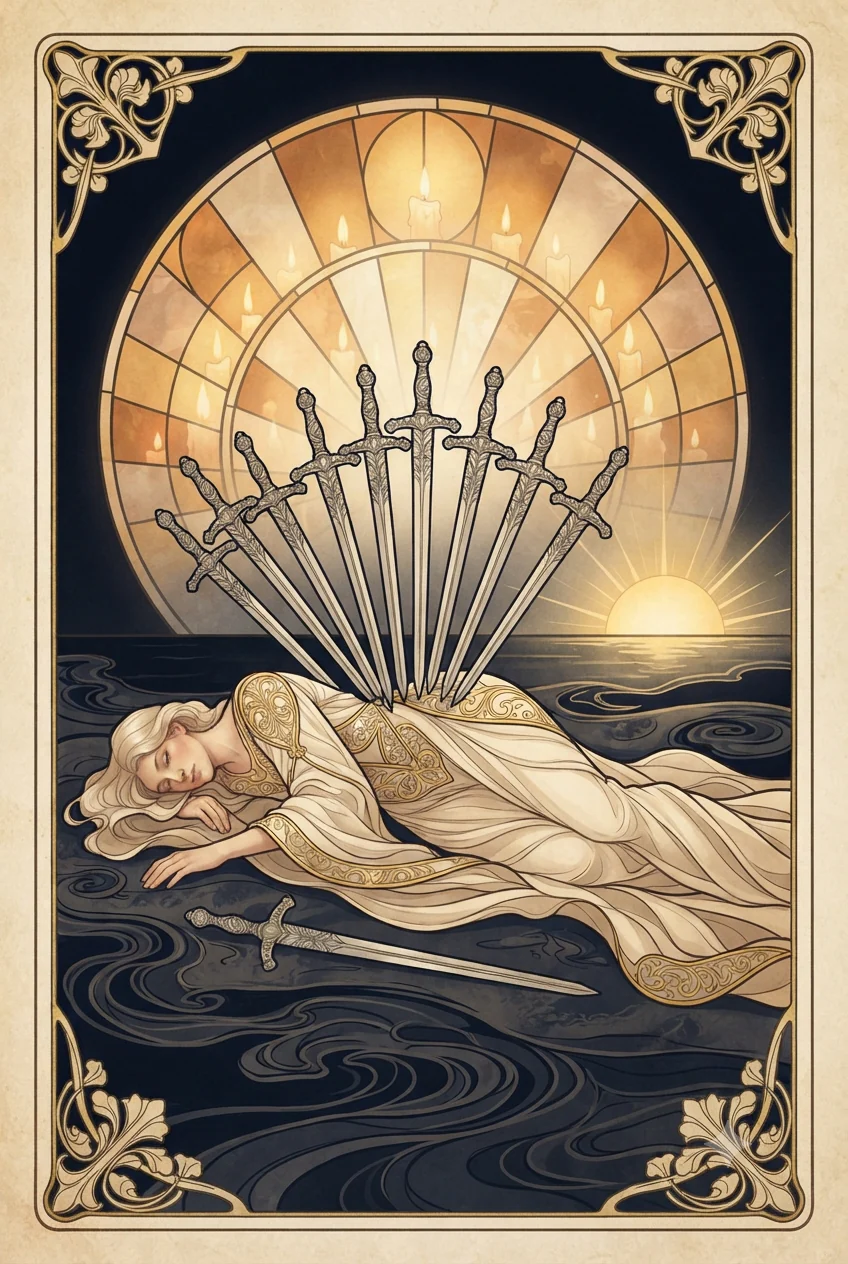
Ten of Swords
Minor Arcana · Swords
Upright
Painful endingRock bottom; a hard chapter closes.
This card holds up a mirror to the moment after the crash — when the thing you feared has already happened and you are still face down in it. The swords are not the attack itself. They are the evidence of an ending that went too far, a situation that cut deeper than it needed to. The card asks what kept you pinned there even after the damage was done. Sometimes it is humiliation, sometimes the story you told yourself about deserving the fall. The upright position does not ask you to get up yet. It asks you to stop pretending the chapter isn't closed. Rock bottom is not a punishment here, just a fact. The only question is whether you can admit you've hit it.
Reversed
The worst is overRecovery begins; only up from here.
Reversed, the card turns toward what begins when you finally roll over. The worst is over — not because circumstances have changed, but because you have stopped pressing into the blades. That shift is small. It might only be the decision to stop replaying the ending or to let someone see the mess. The reversal asks what happens when you stop performing resilience and simply notice the dawn on the horizon. Recovery is not a montage. It is the unglamorous work of pulling one sword out at a time, and this card says you have started.
What the imagery is saying
The figure lies face down, completely still, ten swords buried vertically in the back. The posture reads as surrender — no struggle, no reaching, just the weight of a body that has stopped fighting. The black sky takes up most of the scene, heavy and final, but the horizon is split open with gold. The swords are the only sharp verticals in an otherwise flat landscape where shore meets water. The dawn is not comforting. It is matter-of-fact, a light that arrives regardless of whether the fallen figure is ready to see it.
Where this shows up
In relationships
Appears when a relationship has ended with a clarity that leaves no room for negotiation. The breakup, the betrayal, the friendship that dissolved in a single conversation — the card marks the point where denial costs more than acceptance. It can also point to the role of public failure, a humiliation witnessed by others that compounds the private grief.
In work
Shows up around a job loss, a failed project, or a professional setback that felt like a defining verdict. The card names the cold morning after — when the email has been sent, the decision is final, and the identity you built around the role is suddenly gone. It asks what is left when the title is stripped away.
In how you relate to yourself
Points to an internal narrative that has run its course. The version of yourself you built around a particular story — the overachiever, the caretaker, the one who never fails — has collapsed under its own weight. The card sits with the exhaustion that follows when you stop propping up an identity that no longer fits.
Common misreadings
This card is often read as a prediction of disaster, betrayal, or violent loss — the worst card in the deck, a warning of ruin to come. That reading misses the entire point. The Ten of Swords is not a forecast. It is a depiction of what has already happened. The ten swords are already in the back. The sky is already breaking. The fortune-telling version of this card scares people into hypervigilance when the card is actually asking them to stop scanning the horizon for the next blow and look at the ending they are already living through.
Sit with this
- Describe what ending you are still describing as 'maybe not over yet.' What would it cost you to call it finished?
- If you stopped hiding the part of this that humiliates you, who would you tell first?
- What is one small thing that has already shifted — just barely — since the lowest point?
Draw a personalized spread and receive a reflective reading that ties your cards to what’s on your mind — for self-reflection, not prediction.
Begin a free reading