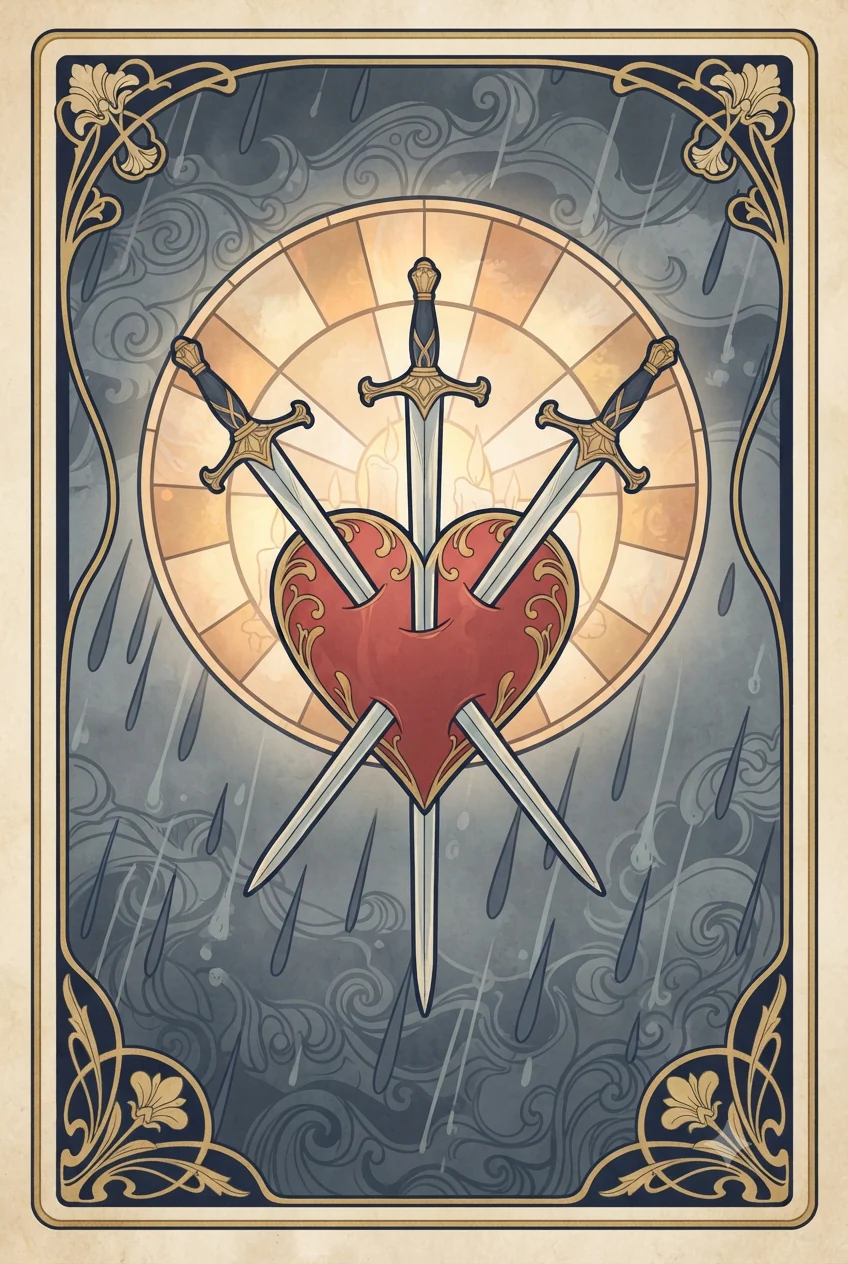
Three of Swords
Minor Arcana · Swords
Upright
HeartbreakPainful truth, grief, a clean cut.
The Three of Swords names the moment a truth lands and it hurts. This is not the ache of slow drift or the bruise of neglect — it is a clean puncture, the kind that arrives with words spoken plainly: it's over, I can't, you didn't. The card pulls your attention to what you now know and cannot unknow. Grief here has shape. Loss has a name. That specificity is the pain and, strangely, the beginning of something honest. The card asks you to stop patching around the wound with distraction or blame. Let the thing be what it is. The swords do not twist. They rest where they entered, and the clarity they bring — unwanted as it is — is still clarity. This is heartbreak as information. Sit with the fact of it before you decide what comes next. The feeling is real, but so is the release of finally admitting why it's there.
Reversed
RecoveryForgiveness; the wound begins to close.
The reversed Three of Swords arrives when the acute phase of pain begins to soften. The wound is still visible, but the edges are drawing together — not gone, not forgotten, but no longer the only thing you see. This is the slow work of recovery, and it asks you to notice what forgiveness looks like when it isn't performative. Not the rushed pardon offered to keep the peace. The quieter kind: the decision to stop reopening the cut with the same memory, the same argument, the same self-indictment. The card points to where you are ready to let scar tissue form. That readiness might surprise you. It can feel like disloyalty to the pain that shaped you. But healing is not betrayal. The reversed Three of Swords sees you beginning to tell the story of what happened without reliving it. The swords are still present. They just weigh less.
What the imagery is saying
A single red heart floats against a grey sky thick with rain that has not yet broken. The heart is anatomical enough to read as real — valves, chambers — but simplified, a clean shape. Three swords pass through it, each one distinct, spaced evenly, their blades entering the heart's upper curve and emerging below. The steel catches what little light the cloud cover allows. Rain hovers in the sky, not falling so much as waiting. The grey is the grey of an overcast afternoon that turned darker than you expected. Nothing in the image is collapsing or shattering. The heart is intact except where the swords enter. The wounding is precise. No blood clouds the scene. The swords are neither being pushed deeper nor withdrawn. Someone chose placement. Someone is holding still.
Where this shows up
In relationships
A truth has been spoken that cannot be unsaid. The card appears when trust is severed cleanly — by a confession, a departure, a line crossed that both people recognize. The pain is specific to one event, not a slow erosion. You are looking at the exact shape of the rupture, and that clarity is its own difficult gift.
In work
Rejection, a project killed, a role eliminated. The loss is definite and the cause is visible: the email, the meeting, the decision handed down. The Three of Swords does not describe office friction or creeping burnout. It describes the clean cut — your name off the door, the funding pulled, the feedback that left no room for interpretation.
In how you relate to yourself
You have just learned something about yourself that hurts to hold. A limit you cannot wish away, a pattern you can no longer excuse, a belief that collapsed under its own weight. The card witnesses you in the aftershock. No fixing yet — just the moment of recognition, raw and precise.
Common misreadings
The most common misreading treats the Three of Swords as a prediction of suffering to come: you will be betrayed, heartbreak is heading for you. That framing misses the point. The card does not forecast pain — it names pain already present. The image is a mirror held to a wound you are currently feeling. Another misreading skips straight to the reversed meaning, urging forgiveness before the upright truth has been felt. You cannot recover from a hurt you have not admitted exists. Pushing someone toward the reversed meaning prematurely is denial dressed as healing. The card, read honestly, says: this is what hurts. Look at it.
Sit with this
- What truth did I receive that I am still trying to argue with, and what would happen if I stopped?
- Where in my body does this particular grief sit, and what does it need me to acknowledge?
- If this pain is a form of clear seeing, what is it showing me about what I truly valued or believed?
Draw a personalized spread and receive a reflective reading that ties your cards to what’s on your mind — for self-reflection, not prediction.
Begin a free reading