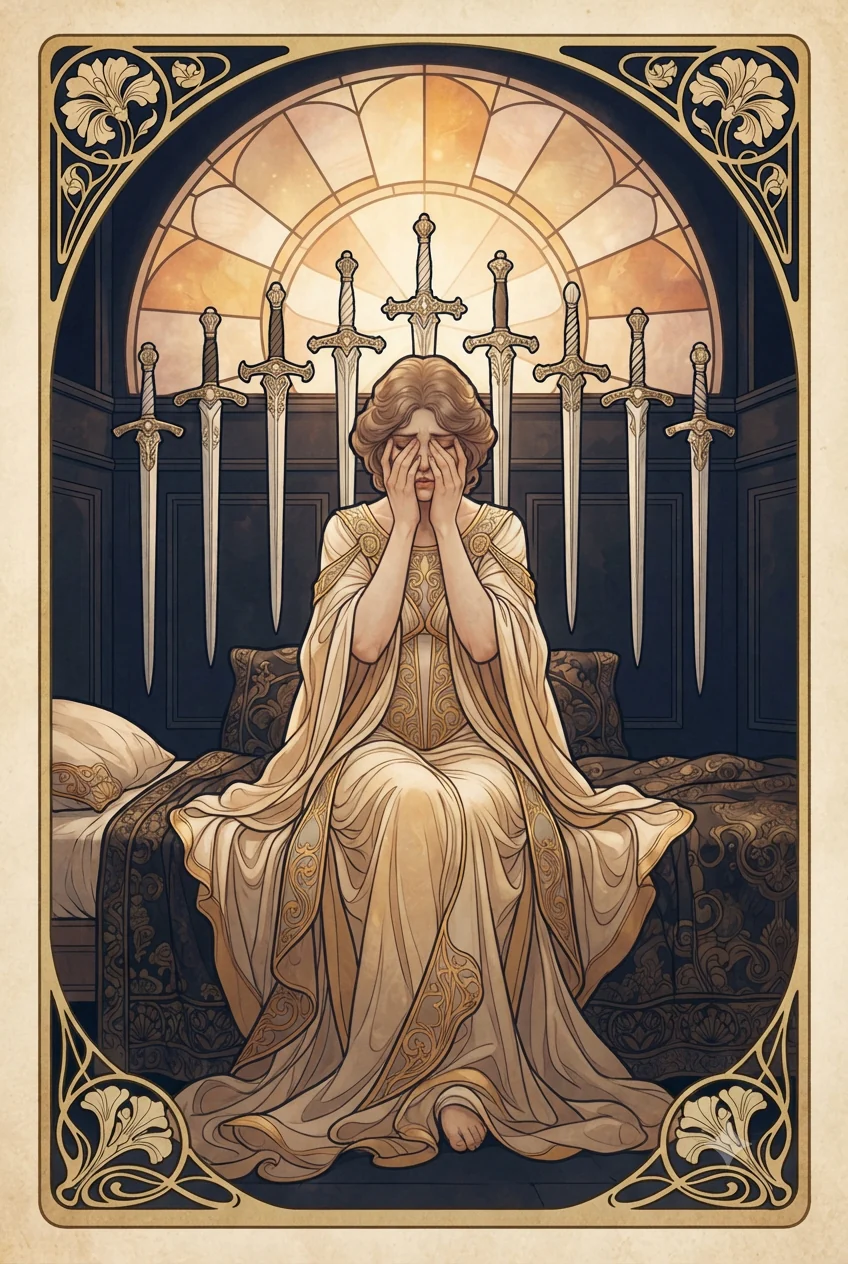
Nine of Swords
Minor Arcana · Swords
Upright
AnxietyWorry and sleepless, circling thoughts.
The Nine of Swords shows a mind running a nightmare on loop. The crisis hasn't happened in the room; it's happening entirely inside the skull. This card asks you to notice the difference between a real problem in front of you and a dread you are rehearsing alone in the dark. The sharpest weapon here is the story you're telling yourself at 3 a.m. — and you're the one holding it. Your hands are over your face, but your mind is holding each sword behind you like a museum exhibit of everything that could go wrong. Noticing that you are the storyteller doesn't make the anxiety vanish, but it does put a crack in the wall wide enough for a little air.
Reversed
Releasing fearHope; the night-fear loosens its grip.
Reversed, this card marks the moment the grip loosens. The fears are still recognizable, but they've lost their authority. What looked like an inescapable loop begins to show its seams. There's a specific relief in admitting the thing out loud — saying "I've been terrified of failing" or "I can't stop picturing the worst" — and hearing it sound smaller in the air than it did inside your head. The row of swords is still on the wall, but you are no longer staring at them. You're seeing the room itself, and the door. The dark is just dark now, not a screen for projections. You can lower your hands.
What the imagery is saying
The figure is upright in bed, not lying down — sleep is not happening. Face buried in both hands blocks out the world, but it also blocks out any source of comfort. The darkness isn't just night; it's the isolation of believing no one else has ever lain awake like this. Nine swords hang in a rigid row on the wall behind, evenly spaced, orderly, impossible to ignore. They aren't being swung. They aren't falling. Their power comes entirely from their presence in the room and the mind's insistence on counting every single one. The blank wall behind the swords offers no distraction, no alternative image — just the mind's own inventory of terrors arranged like a display.
Where this shows up
In relationships
Shows up when a single offhand comment replays into a full catastrophe. You're lying awake reconstructing a partner's tone or a friend's silence, building a case against yourself that no one else is arguing. The real conversation didn't happen in words; it's happening now, in your head, with an imaginary jury.
In work
Appears as the Sunday-night dread spiral. A deadline, a presentation, an email you haven't sent — one unresolved thing metastasizes into certainty of failure. The actual work is often far smaller than the anxiety about it. The card points to mental rehearsal that has crossed the line into self-sabotage.
In how you relate to yourself
The inner critic has taken the night shift. This card reflects a mind that has confused vigilance with virtue — if you worry hard enough, maybe you can prevent the bad thing. But the vigilance is the punishment. The figure isn't solving anything; they're just exhausted. Their own hands are the only thing covering their face.
Common misreadings
This card is frequently misread as an omen of actual disaster — a warning that the worst is coming. That turns a mirror into a prophecy and hands the swords more power than they have. The Nine of Swords doesn't describe an external event approaching; it describes an internal state already present. The real subject is the spiral, not the feared outcome. Reading this as "something bad will happen" is using the card to feed the exact anxiety it's trying to illuminate.
Sit with this
- What thought visited you last night or early this morning that you haven't said out loud to anyone?
- When has a feared outcome actually happened, and how did the reality compare in size to the dread that preceded it?
- Describe the room around you right now in concrete detail — light, sound, objects. What changes in your body when you shift attention from inside your head to outside it?
Draw a personalized spread and receive a reflective reading that ties your cards to what’s on your mind — for self-reflection, not prediction.
Begin a free reading