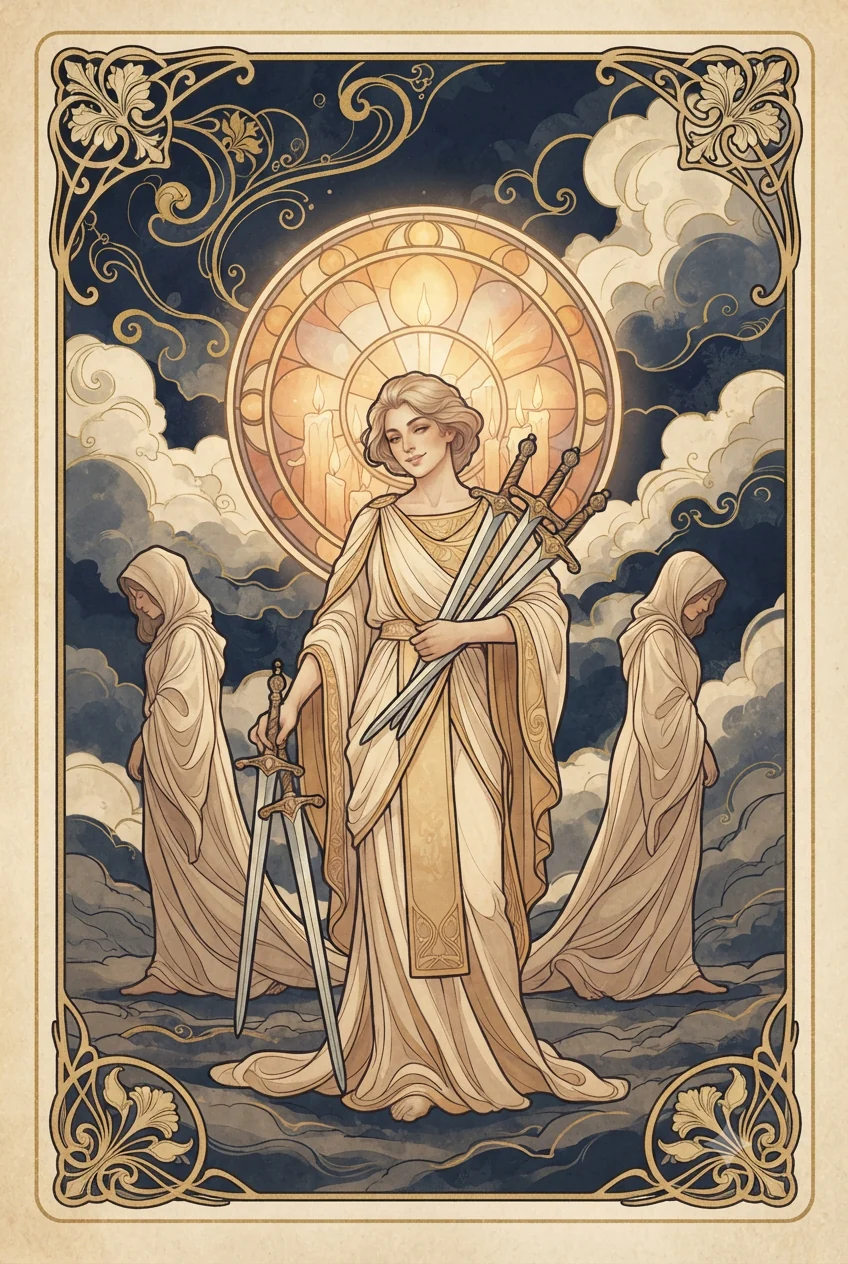
Five of Swords
Minor Arcana · Swords
Upright
ConflictA win at a cost, or a battle better left.
The Five of Swords places a hollow victory square in front of you. It asks whether the win you just claimed, or are tempted to claim, required you to leave someone else holding the shorter end. This is not a card about strength — it is a card about the moment after, when the rush of being right fades and you are left holding an armful of swords and nobody is standing beside you. You get to decide what that silence means. The smugness on display here is a mirror for your own satisfaction. Notice if your first instinct is to justify it. Notice if you feel a flicker of regret. The cost is already visible in the backs of the people walking away. The question is whether the prize was worth the isolation it bought.
Reversed
ReconciliationMaking peace; walking away wiser.
Reversed, the Five of Swords turns its attention to the aftermath you cannot ignore any longer. You have stopped gripping the conflict and started asking what it cost you. That shift is not weakness — it is the move from winning an argument back toward holding the relationship. This card asks you to notice the relief that comes with laying the swords down, even if your hands feel empty without them. It points to the moment where an apology forms, where pride loosens its hold just enough for you to turn toward the people you hurt. Sometimes that turning is quiet: you simply stop fighting. The windswept sky has not cleared, but you are no longer facing into the gale alone. Something ragged is beginning to mend.
What the imagery is saying
A single figure stands in the foreground, smirking, arms loaded with swords gathered close to the chest. The grip is possessive, the expression satisfied in a way that leaves no room for anyone else. The sky behind is a windswept mess of tattered grey, pulling the whole scene into a restless, uncomfortable light. Two other figures walk away in the middle distance, heads bowed, shoulders dropped. They carry nothing. Their emptiness is the price of the smirk. The swords are the only objects that matter here — the winner holds several, the losers hold none, and the ground between them is bare.
Where this shows up
In relationships
The dynamic where one person uses words to decisively win an argument while the other shuts down and withdraws. Being right has become more important than being close, and the distance afterward is filled with unspoken resentment. Someone is walking away bowed.
In work
A competitive environment where a colleague claims credit or a victory at the expense of team cohesion. The achievement is real, but the corridor has gone quiet. The win isolates more than it advances. The smirking figure gathered the swords, and now works alone while the people who could have shared the load turn their backs and walk toward a different horizon.
In how you relate to yourself
The internal conflict that leaves you refusing to forgive yourself for a past mistake. One part of you gloats over another part that is forced to walk away ashamed. The harsh self-criticism feels righteous but leaves an empty exhaustion.
Common misreadings
This card is often read as a prediction of unavoidable defeat or betrayal — a warning that someone is about to stab you in the back. That turns it into a fortune-telling tool that breeds paranoia. The Five of Swords does not describe what will happen to you. It describes what you are doing right now: the smirk you recognise in yourself, the argument you pushed too far, the moment you chose victory over connection. The bowed figures are not omens of future enemies. They are the part of the situation you are ignoring. The correction is to stop scanning the horizon for a villain and look at whose arms are full of swords.
Sit with this
- Describe a moment when you won an argument but lost something that mattered more than being right. What did you notice in the silence that followed?
- What would you need to set down right now — a grudge, a need to be right, a sharp word — in order to feel less alone in the wind?
- Look at the two bowed figures walking away. Which one carries a feeling you have been unwilling to acknowledge in yourself?
Draw a personalized spread and receive a reflective reading that ties your cards to what’s on your mind — for self-reflection, not prediction.
Begin a free reading