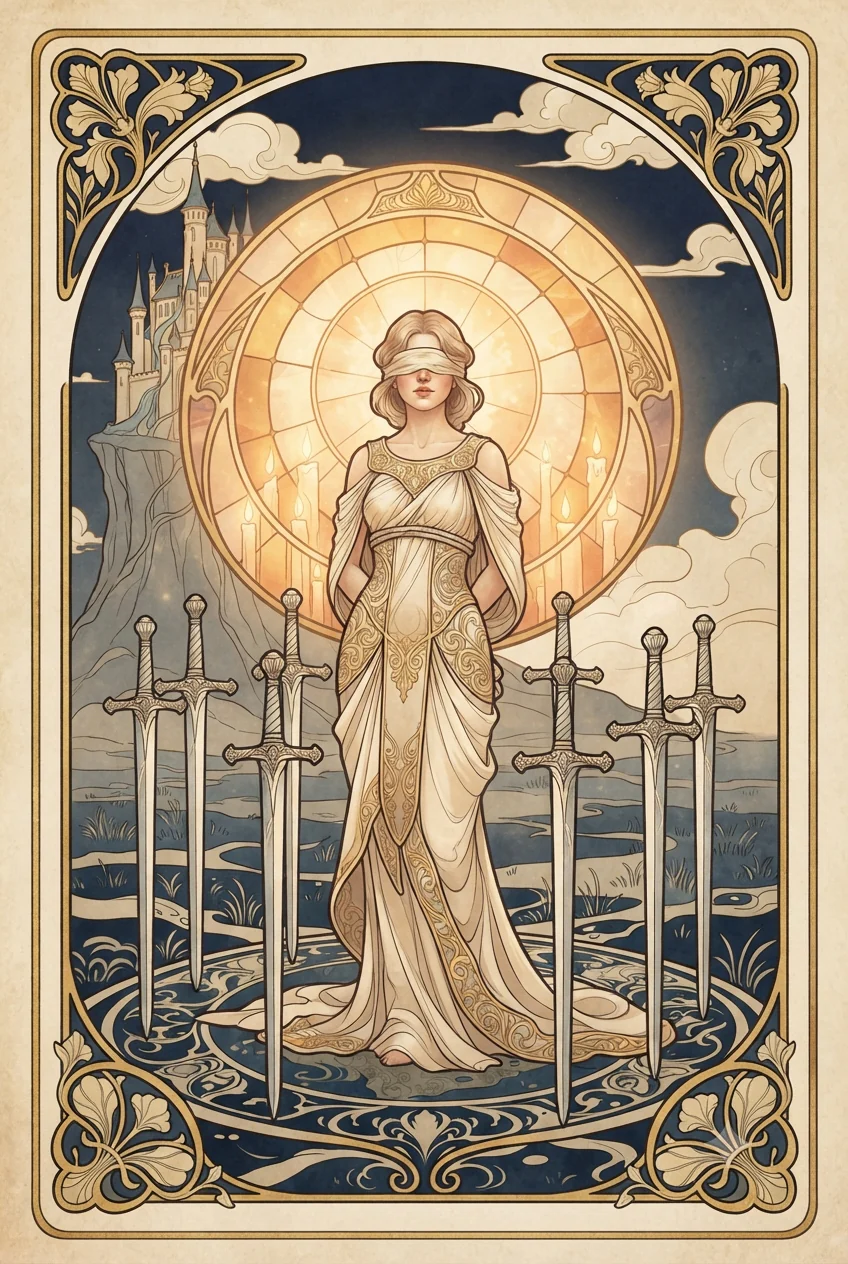
Eight of Swords
Minor Arcana · Swords
Upright
RestrictionFeeling trapped by your own thoughts.
Restriction wears convincing disguises—it often looks like an outside force, a person who boxed you in, or a situation with no exits. The Eight of Swords points you back toward the voice doing the boxing. The bindings and the blindfold are loose enough to slip, if you test them. Right now, the tightest knot is a thought you have stopped questioning. It might be a story about what you owe, what you cannot risk, or who would be disappointed. The card does not ask you to break free immediately. It asks you to notice that you have been standing still because moving felt dangerous. What feels dangerous is usually just familiar discomfort wearing a warning label. The marshes underfoot are unstable, but they are not bottomless. The castle on the cliff is not a refuge you were cast out of—it is a perspective you might reach if you stop believing the blindfold is doing you a favor.
Reversed
FreedomCutting yourself loose; a new view.
The reversed card is not a guarantee of escape; it is the moment you realize the bindings were never locked. One hand has already worked loose. The swords no longer look like a cage—they look like a boundary someone else drew and you accepted without checking. Freedom here is not a triumphant march toward the castle. It is quieter. It is the decision to pull the blindfold down and let your eyes adjust to unmediated light. The thoughts that held you in place are still nearby, still recognizable, but they have lost their authority. You see them now as habits, not truths. The marshy ground is still tricky, but you can watch your footing when your eyes are uncovered. This card asks what you do with a sudden surplus of clarity that you were not expecting—and what story you stop telling yourself the moment you turn your head.
What the imagery is saying
The blindfold is the center of the image. It is tied by someone who knows how to make a knot look tighter than it is, and the figure has not tested it. Eight swords stand in the ground at irregular intervals; they are not a cage built by a blacksmith but a perimeter the figure has accepted as impenetrable. The spaces between them are wide enough to walk through sideways. The bindings around the arms and torso are wrapped, not cinched—they suggest restraint more than captivity. Below the figure, the ground is wet and uneven. One wrong step means a stumble, but the figure is not sinking. On the cliff in the distance, a castle catches whatever light is available. It is notable that the castle is above the scene, not behind it—getting there means moving forward and then upward, not backward into some lost safety. The figure is barefoot, which makes every step a negotiation with the cold ground.
Where this shows up
In relationships
A dynamic where someone believes they cannot speak honestly without causing collapse. The cage is made of avoided conversations and assumed reactions. Silence feels like protection but functions as a slow leak—pressure builds, distance grows, and both people notice the air thinning.
In work
Competence without confidence. A person who second-guesses every decision because a past mistake rewrote their self-assessment. The role fits, the skills are present, but an internal narration of impending failure keeps them over-preparing and under-claiming. The swords in the card are spaced widely—the exit is there, but looking at the obstacles instead of the gaps becomes the full-time job, and the work itself stalls.
In how you relate to yourself
The habit of treating anxious predictions as facts. Every possible negative outcome is rehearsed until it feels inevitable. The self that could act is waiting behind a story about what acting would cost—a cost that has never actually been paid because the step was never taken.
Common misreadings
The most common misreading treats the Eight of Swords as a card of external imprisonment, or worse, as a prediction that someone is about to be trapped by circumstances. That misses the card's entire mechanism. The figure in the image is not in a locked cell; the swords are spaced apart, the bindings are not tight, and the blindfold is self-maintained. Reading this as a forecast of unavoidable hardship lets the querent off the hook in a way that feels kind but is actually disempowering. The harder, more useful truth: this card shows a pattern of thought that mimics imprisonment well enough to be mistaken for it. Seeing that pattern is the first loosening of the knot. No one is coming to remove the blindfold because no one put it there.
Sit with this
- Describe the last time you stopped yourself from saying something because you were certain of how the other person would react—and whether that certainty was ever confirmed.
- What belief about your own limitations are you protecting by refusing to test it?
- If the blindfold came off right now and you saw a clear path between two of the swords, what would you do in the first sixty seconds?
Draw a personalized spread and receive a reflective reading that ties your cards to what’s on your mind — for self-reflection, not prediction.
Begin a free reading