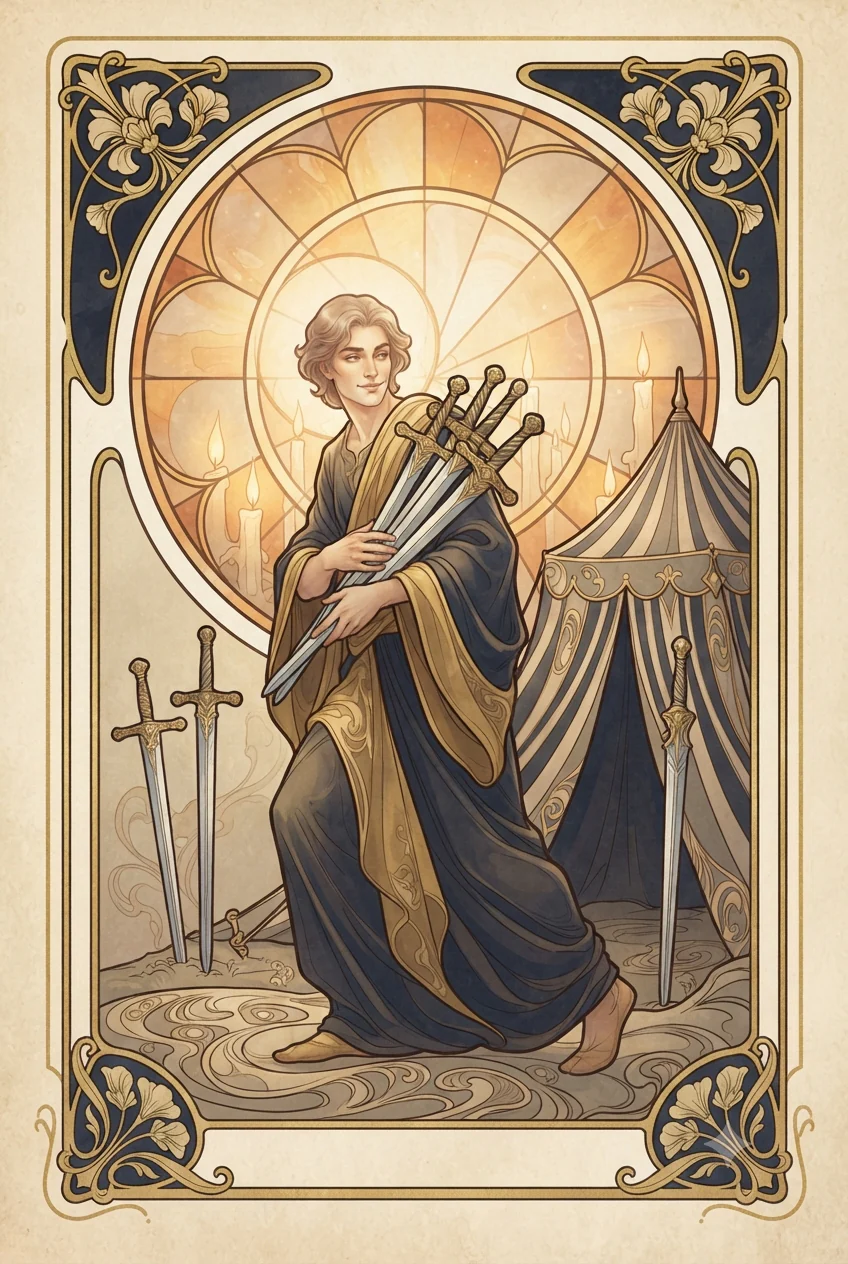
Seven of Swords
Minor Arcana · Swords
Upright
StrategyCunning, stealth, getting away with it.
The Seven of Swords upright puts a quiet, calculating move in front of you — the moment you decide to act alone, keep your own counsel, or withhold information because disclosure feels too costly. This is strategy as self-protection, not malice. The figure in the image isn’t fighting; he’s extracting something he believes he needs, and he’s doing it quietly. The card asks you to notice where you are operating solo, sidestepping permission or consensus. It doesn’t condemn the impulse. It simply holds up a mirror: here is the choice to move unseen, to take what you think is yours, to rely on your own wits. The question it leaves with you is what you’re carrying away and what you’re leaving behind — and whether the calculus still feels right in the light of day.
Reversed
ConscienceConfession; conscience catches up.
Reversed, the Seven of Swords turns the sly glance inward. Where the upright card was about getting away clean, the reversal is about the weight that settles in afterward — the thing you can’t un-know about your own actions. Conscience here isn’t punishment; it’s the internal tally that upright cleverness tried to outrun. You might be facing a moment of reckoning where a withheld truth is surfacing, or where the loneliness of the solo maneuver is suddenly louder than its payoff. The card doesn’t demand confession to anyone else. It points to the confession you make to yourself, the one that arrives when the adrenaline fades and you’re left with what you actually did. That’s the conscience catching up — not as judgment, but as clarity you can no longer avoid.
What the imagery is saying
A striped camp sits in the background, tents receding, a community left undisturbed. Five swords are cradled in the figure’s arms — an awkward, heavy bundle, blades pointing backward. His head is turned, the glance both checking for pursuit and measuring the distance already gained. Two swords remain upright in the ground behind him, planted exactly where he took the others from. They stand like a question he chose not to answer. The five he carries are the choice he made; the two he left are the cost of it. Nothing in his posture suggests triumph. His body is bent around the blades, moving away from what he didn’t take.
Where this shows up
In relationships
A pattern of withholding — not necessarily betrayal, but a calculated silence that protects one person at the expense of transparency. One partner is moving quietly around a hard conversation, carrying the emotional logic alone and leaving the other with only what remains planted in plain sight.
In work
Operating outside formal channels. This might be the strategic end-run around a bottleneck, the idea developed off-book, or information shared selectively to control an outcome. The camp in the background is the team that doesn’t yet know what’s been removed.
In how you relate to yourself
The part of you that hedges, plans an exit while smiling, or refuses to show your full hand even when there’s no opponent. It’s the internal strategist who treats vulnerability as a tactical error — and the fatigue that accumulates from never putting the swords down.
Common misreadings
This card is often misread as a straight omen of betrayal — someone is deceiving you, or you are about to be victimized. That’s fortune-telling flattening a complex mirror into a warning. The Seven of Swords isn’t a prediction about who will wrong you. It’s an invitation to examine your own relationship with strategic silence: where you’re rationing truth, what you’re extracting without full disclosure, and why the open approach feels unavailable. Even when the card reflects an external deception, the sharper question isn’t who’s lying. It’s what made this environment one where truth couldn’t walk through the front gate.
Sit with this
- What am I carrying right now that I’ve decided no one else needs to know about — and who am I protecting by keeping it?
- Describe the two swords I left standing. What didn’t I take, and why did I choose to leave those particular things behind?
- When did my conscience last catch up to something my cleverness pulled off — and what did that reckoning sound like in my own voice?
Draw a personalized spread and receive a reflective reading that ties your cards to what’s on your mind — for self-reflection, not prediction.
Begin a free reading