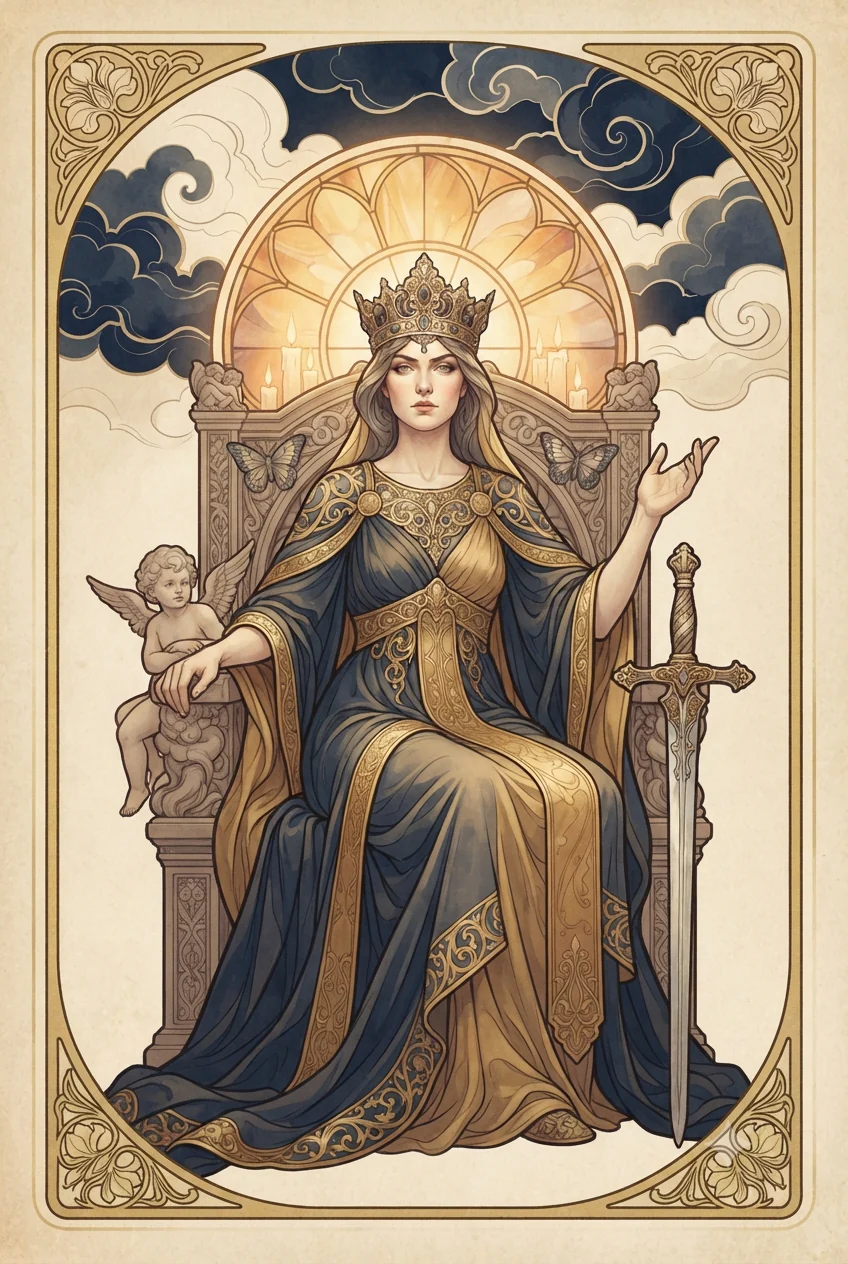
Queen of Swords
Minor Arcana · Swords
Upright
Clear judgmentIndependence and unclouded reason.
The Queen of Swords upright is not about being liked. It is about seeing through sentiment to what is actually there. This card asks you to notice where you are pretending not to know something because the truth is inconvenient or uncomfortable. Clear judgment means naming the pattern, cutting the rationalization, and letting the conclusion stand even when it costs you a comforting illusion. This is independence of mind—the refusal to let belonging require you to lie to yourself. The hand raised is not a wave; it is a boundary held steady. The sword points up because discernment elevates, even when it stings.
Reversed
ColdnessDetachment hardening into bitterness.
Reversed, clarity curdles into armor. The same sharp mind that once cut through confusion now cuts people away—not from necessity but from a reflex of preemptive rejection. This is what happens when independence calcifies into isolation, when needing no one becomes a belief that no one is worth needing. The bitterness here is not random. It is the scar tissue of old disappointments, held so tightly that new arrivals are judged before they can speak. The ask is to notice where you are mistaking cynicism for wisdom, or treating your own hurt as proof of everyone else's failing.
What the imagery is saying
The throne tells the story the queen does not say aloud. Carved cherubs and butterflies sit beneath her rigid posture—softness and transformation built into the seat of authority itself. She does not lean on them. The sword in one hand stays perfectly vertical, not cocked for a strike but held as a tool of alignment. Her other hand is raised, open and still, a gesture of clear refusal rather than invitation. Clouds mass behind her, but they do not touch her crown. The sternness in her face is not anger. It is the effort of holding a complex thought without flinching.
Where this shows up
In relationships
The Queen of Swords appears in relationships when honesty has become the battleground. One person is done with ambiguity and demands a direct accounting; the other may experience this as cruelty. The pattern shows up wherever kindness and truth feel like opposites, and someone chooses truth. It can be the card for a necessary breakup conducted with surgical precision, or for the quiet distance that enters a partnership when one person stops managing the other's feelings.
In work
Here the card points to a moment of evaluative clarity: a decision that must be made without favoritism, a performance review that cannot fudge the facts, a project cut despite sentimental attachment. The Queen of Swords at work values the right answer over the popular one. It can describe a leader who refuses to be warm just to put others at ease, or a coworker whose feedback lands hard but is never personal—and who expects the same standard in return.
In how you relate to yourself
Internally, this is the part of you that watches your own excuses with a raised eyebrow. It is the willingness to audit your own narratives without self-pity. When this card lands in a self-reading, you are being asked to stop negotiating with a truth you already know. The clarity is already present. What remains is the decision to act on it rather than waiting for certainty to feel nicer.
Common misreadings
This card is commonly softened into something it is not. Readers who want every queen to be nurturing turn her into a wounded mother or a lonely professional who just needs a hug. That misreads the entire suit. Swords are the element of thought, and the Queen of Swords is sovereign over her own analysis. She is not waiting to be warmed up. Another misreading treats her as a fortune-telling signal that a legal battle or divorce is coming—a prediction the card makes no claim to deliver. It does not forecast conflict. It names the clarity that is already available and asks whether you are willing to hold it upright.
Sit with this
- What truth have I been softening or delaying because speaking it plainly would unsettle someone I care about?
- Where am I reaching for cynicism or dismissal as a shortcut to avoid feeling disappointment again?
- Describe a moment when my own clear thinking cut through a situation I had been rationalizing. What did I notice first?
Draw a personalized spread and receive a reflective reading that ties your cards to what’s on your mind — for self-reflection, not prediction.
Begin a free reading